3 minute read

HBO's behind-the-scenes footage for House of the Dragon season 3 reveals how the production built two full-scale ship rigs and purpose-built tanks at Leavesden to film the Battle of the Gullet. The practical scale is impressive.
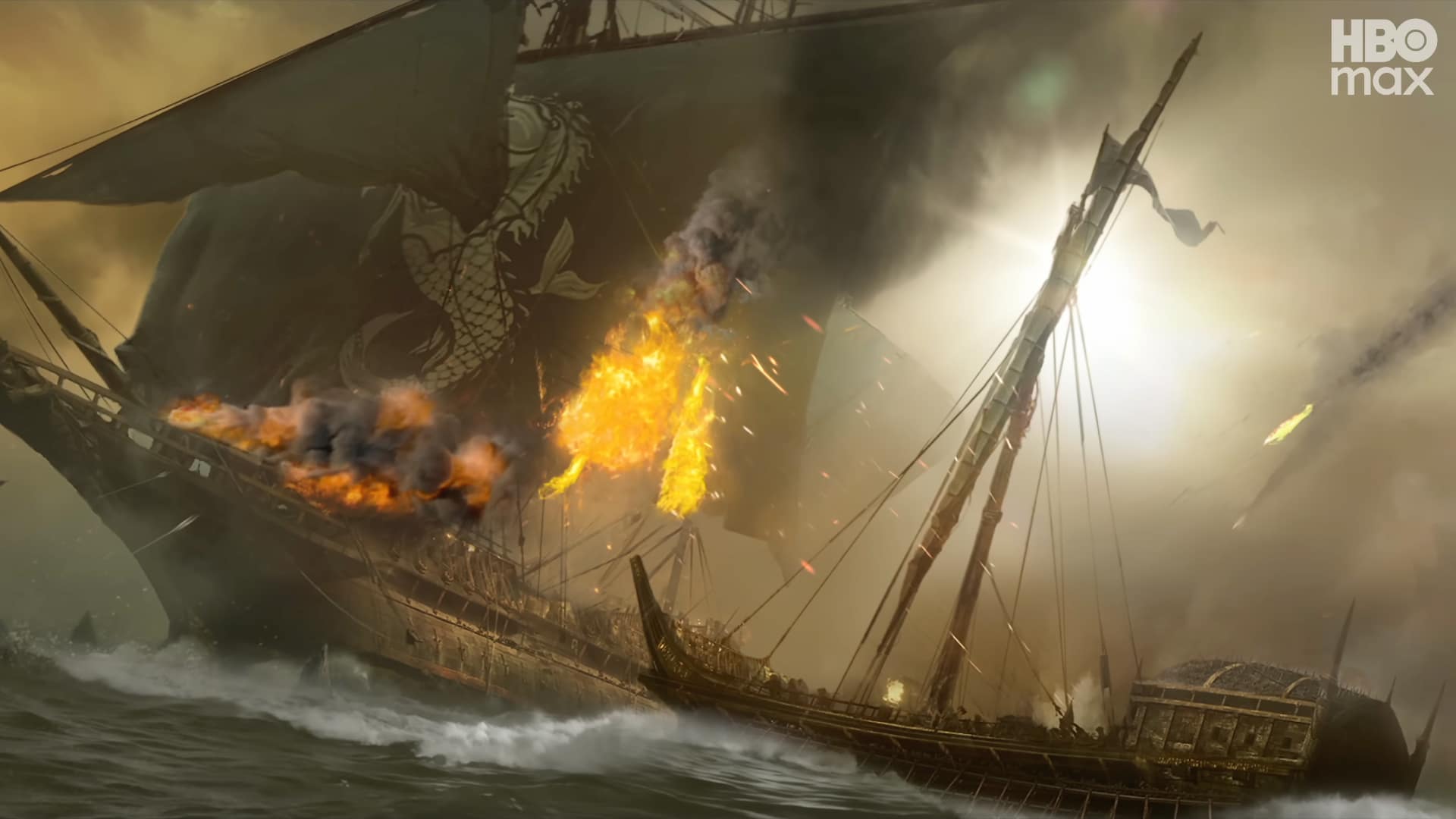
Like Game of Thrones before it, House of the Dragon gets a lot of things wrong, but when it pulls out all the stops to film a spectacular battle sequence it tends to hit it out of the park. And with The Battle of the Gullet, which takes up much of the end of the season 3 premiere, it has staged the most epic small screen battle since GoT’s Season 8 The Long Night.
Unlike that infamous example, it chose to shoot this battle in daylight. But, to make sure there was at least some degree of difficulty involved, the battle takes place at sea. HBO has already released the BTS of the enormous effort involved and it is a fascinating watch.
Spoilers ahead, mateys…
The battle was structured across three narrative theatres: an aerial theater following Jacaerys, Baela, and later Rhaena on dragonback; and a sea theater split between different characters: Alyn and Corlys on one side and the Triarchy's Lohar and Tyland on the other. VFX producer Thomas Horton says this structure meant the dragon sequences and ship sequences had to be locked together editorially before the shoot began. Editors were brought in early to work through the dragon choreography in pre-vis, ensuring the aerial and sea storylines tracked coherently as a single battle.
A lot more than just VFX went into the sequence, however, with practical builds doing much of the heavy lifting.
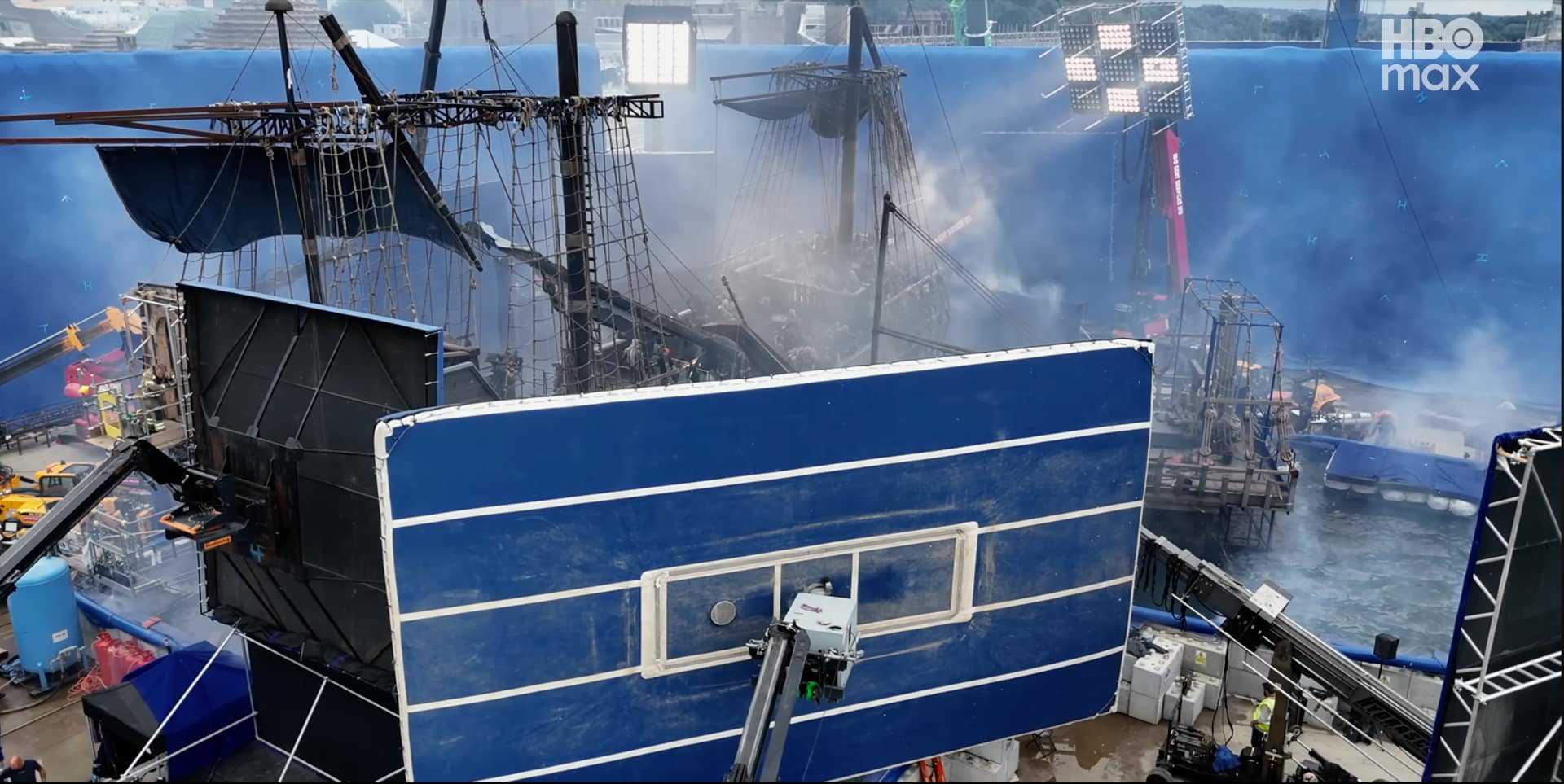 No LED volume, but plenty of bluescreen needed to comp in the multiple VFX shots
Production designer Kevin de la Noy credits his time on James Cameron's Titanic, working with Cameron and producer Jon Landau, as the foundation for his approach. He proposed building not one but two purpose-built tanks on the production's backlot at Warner Bros. Studios Leavesden in Hertfordshire, UK.
Episode director Loni Peristere admits he questioned the logic of that: "I asked him, 'What do you need a dry tank for and a wet tank for? Why can't you just use one tank?' And he said, 'Well, you want people to go into the water, don't you?' And I said, 'You built the Titanic, I trust you.’"
The groundwork had been laid at the end of season two. Construction coordinator Danny Gulliver notes the team spent that wrap period developing the backlot ground specifically to support future large-scale builds. When season three began, de la Noy's instruction was straightforward: dig two large holes, fill one with three million litres of water, and install a rolling sea gimbal in the other.
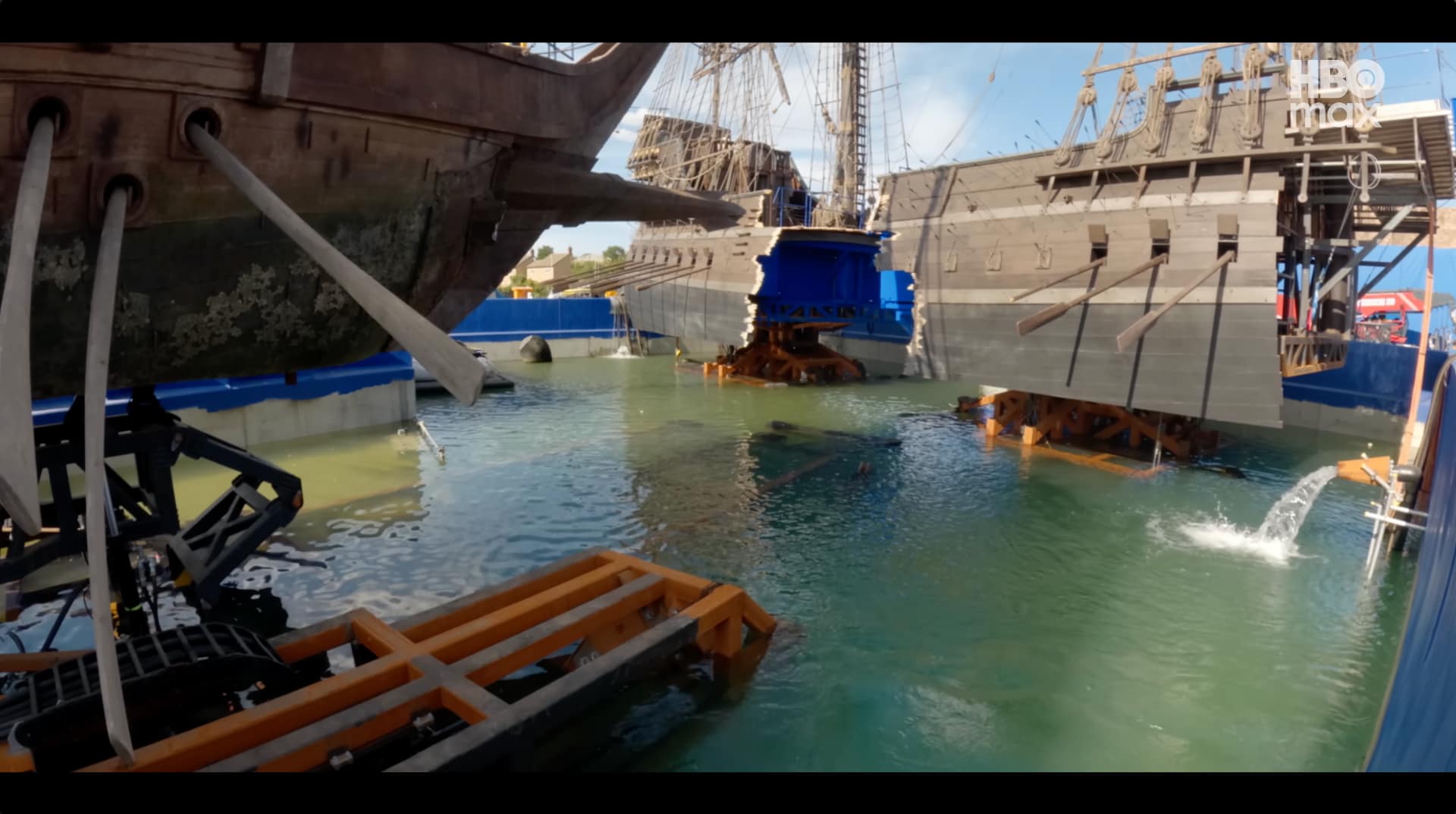 The two full-scale ships in the Leavesden wet tank, each mounted on an independent gimbal rig visible beneath the waterline
The result was two tanks: a dry tank and a wet tank. The dry tank houses a massive gimbal capable of pitch and roll along the full axis of a ship, bow to stern. The first vessel placed on it was The Queen That Never Was, which ran over 38 m (125 ft) in length. At peak operation, the gimbal moved the entire ship with 115 cast and crew on board.
Because camera movement tends to cancel out the gimbal's motion when shooting from aboard the ship, the team kept cameras at a distance, framing wide enough to include the ship's movement in shot.
The dry tank also staged the sequence's most technically demanding stunt: a simultaneous ten-person burn across the full deck of a ship. Stunt coordinator Rowley Irlam describes it as something the production had never attempted at that scale — strafing an entire vessel rather than isolating individual burns on open ground.
For sequences requiring the cast to be in direct contact with water, the production built a second tank. This took two and a half hours to fill from empty and the water was changed twice daily; that’s nearly 2.5 Olympic swimming pools of water filtered and replaced every 24 hours.
Two full-scale ships were rigged in the wet tank: The Queen That Never Was (cut in half for the collision sequence) and the Triarchy vessel, the wonderfully named The Bitchfist, each mounted on its own independent gimbal. The independent drive of each gimbal is what makes the collision sequence work so well. The Bitchfist's gimbal accelerated it into the impact, then immediately pitched and rolled on contact.
The death of Jacaerys Velaryon required a third, bespoke rig. Actor Harry Collett was placed in a dragon saddle mounted on a six-axis motion base especially designed to operate submerged.
“I drowned him, not once, not twice but six times. The guy never cracked,” comments Peristere. “Harry was an absolute trooper and I think has one of the most special on-screen deaths I've ever been a part of.”
And given the amount of deaths that usually take place in Westeros, that’s saying something.
Tags: Post & VFX Practical FX House of the Dragon


RedShark 2020 @ All rights reserved.

Comments