4 minute read

AJA's ColorBox is redefining how productions handle color on set — from single-camera dramas to 27-camera live tours. We talk to AJA Video Systems EMEA Technical Director, Andy Bellamy, about why the problem isn't solved yet.
Color has always been central to AJA’s business. Though John Abt founded the company over 30 years ago with the aim of solving emerging signal conversion challenges, preserving color spaces was baked into the company’s work from the start.
"At the time, the NTSC world was well known as a bit of the wild west of color spaces," said Andy Bellamy, AJA EMEA Technical Director. “AJA was one of the first companies to try to bring order to it all.”
Its frame synchronizers gave early users the ability to apply color correction on the fly at the point of ingest. But the real breakthrough, Bellamy said, came with the FS-HDR, which launched in 2017.
Designed for SDR-to-HDR transformation and camera log conversion in live and outside broadcast environments, the technology’s release marked a tipping point. AJA began investing more heavily in color as a discipline, rather than a side effect of conversion that had to be managed.
FS-HDR was also the first product released as a result of the company’s relationship with Hungarian developer Colorfront. The extremely well-regarded Colorfront Engine color processing system sits at the heart of the FS-HDR, and its color science still informs AJA's approach to color to this day.
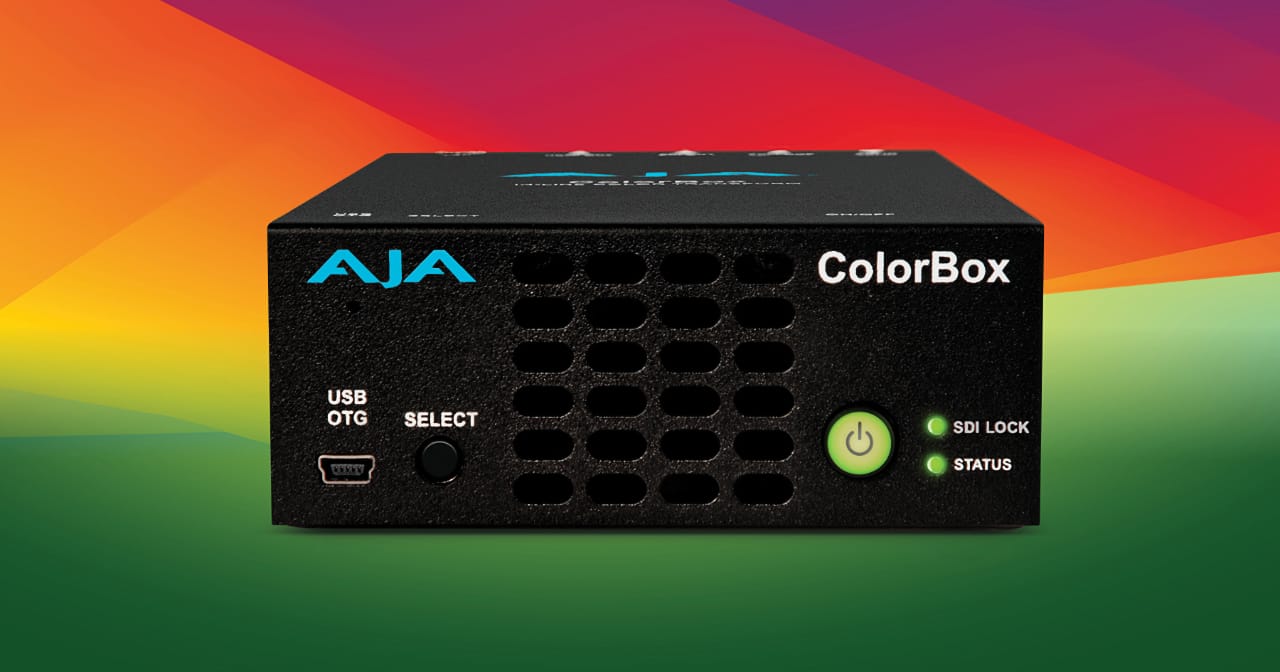
The FS-HDR was just the start, though. AJA ColorBox, which debuted at IBC2022, is where AJA’s vision for color management and conversion crystallized into a compact box. Small enough to sit comfortably on a production cart, it accepts 12G-SDI feeds and applies color space transformations in real time, with sub-frame latency. That means it’s ideal for live event work where any perceptible delay is unacceptable.
But latency is only half of the story. Most productions today involve multiple camera types with different outputs and color spaces, yet the production needs to maintain consistent color across every camera and take. The ColorBox includes a frame store, allowing operators to grab a reference frame from any camera and shade against it directly.
"You can work with it using a browser on a laptop," Bellamy explained, "but if it's in live mode, it interfaces directly with a control surface, which gives you the absolute fine-tuned control with pots and dials.”
The result is a level playing field regardless of the camera types in the chain. Sony, alongside ARRI. ARRI, alongside something else entirely. The ColorBox handles the camera matching with its extensive shading support. It also outputs HDMI as well as SDI, so an operator can feed the correctly transformed signal to whatever monitor is on hand, not just a broadcast-grade display. The device's browser-based interface serves up to any laptop over Ethernet, or via a third-party WiFi adapter for wireless access on set.
When deployed at scale, the ColorBox streamlines how modern productions actually function. "The critical question productions must ask is: who needs to see what, and how do they need to see it?" Bellamy said. The box supports multiple outputs simultaneously, each with its own color correction applied.
That means that the director can see one view, the DIT another, and the client something else again; each receives the precise information they need to make decisions on what is happening in a production. An on-screen metadata overlay shows the operator precisely what's coming in, the color space it's using, and where it's going, without that information cluttering the other monitors on set.
At one end of the deployment scale, a recent live tour for a major female recording artist used 27 ColorBoxes across 27 cameras for a fully calibrated, HDR-correct live production. The whole fleet was locked to calibration settings before each show started, then held consistent throughout, giving a striking demonstration of how well ColorBox’s per-channel design scales.
At the other end, a single-camera drama might use one box to ensure the look agreed in pre-production survives into post. Camera Corps, the UK-based specialty camera specialist behind some of the world's most demanding broadcast deployments – including the last big summer games – uses ColorBox to bring older high-speed cameras that don't natively support HDR into modern HDR workflows without writing off existing kit.
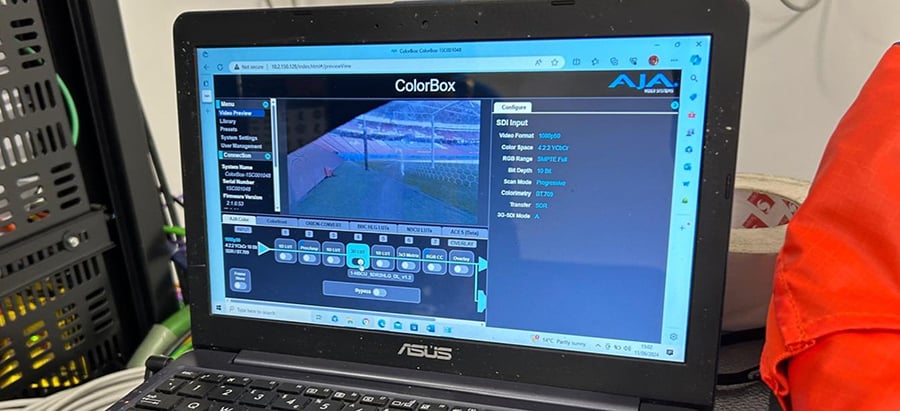 ColorBox in use on a Camera Corps production
For the event, the team deployed ColorBox to handle HDR conversion of dual-output high-speed cameras used for events such as the pole vault and high jump, combining them with AJA Mini-Converters for signal format conversion across multiple venues. The compact form factor was essential: getting color-correct HDR signals out of specialty cameras that must physically mount on sporting apparatus leaves no room for large conversion hardware.
But the technology is even finding a place in the AV market. AbelCine and systems integrator Diversified have built a LUT-based ColorBox workflow for high-end faith broadcasts in the US; organizations running weekly live streams that need to look as consistent and polished as a major concert special.
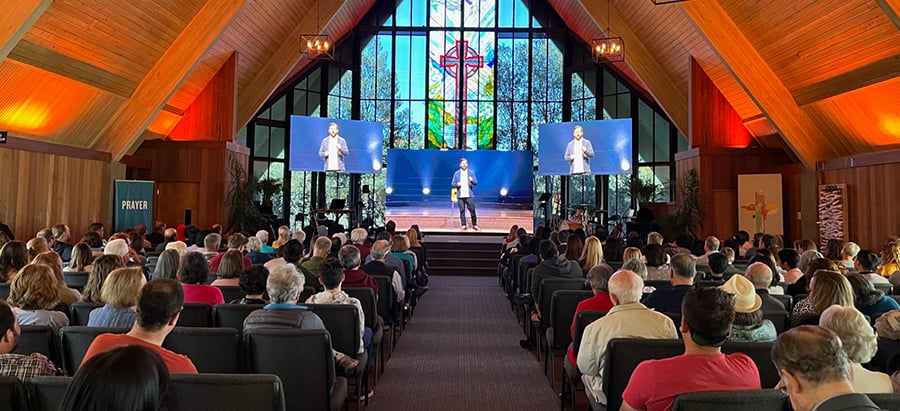 ColorBox is helping level up faith broadcasting operations across the US
At Transformation Church in Tulsa, Oklahoma, the team replaced a complex, variable per-camera shading process with a ColorBox pipeline running log signals through a managed LUT. The first week it went live, the production team received messages from viewers asking what had changed. The answer was simply that the color was now being handled as a central part of the workflow rather than as an add-on. The result shows on screen.
The OG-ColorBox, the openGear variant, is often deployed for these kinds of installations. It is possible to install six to ten cards into a single shared frame, giving clean access to LUT management across an entire multi-camera system.
It would be reasonable to assume that a decade into serious HDR production, most of the hard color problems have been solved. However, that’s a misconception. Bellamy sees the status quo as being slightly more nuanced.
On the one hand, the ACES compliance work, ensuring end-to-end color accuracy for high-end 4K/12-bit acquisition under the Academy's open color pipeline, was a genuine technical frontier, and he's satisfied it's been met. And, of course, ColorBox supports ACES via OpenColorIO, alongside BBC Hybrid Log Gamma and NBC Universal LUT sets as built-in options.
What remains to be conquered isn't so much unsolved as unfinished. "I think it's more about continuing to refine the process of use on set," Bellamy noted. The underlying color science is stable; the opportunity is in making the workflow cleaner, faster, and more intuitive for the people running it under pressure.
Cameras from the same manufacturer still vary unit to unit, and even if that changes, human visual perception still differs from person to person, which won’t. That means the case for reference-locked hardware isn’t going away any time soon.
"In an ideal environment, at AJA we give the colorist or DIT every opportunity to make the best of whatever's in front of that expensive production," Bellamy explained.
The simple truth is that when the look is locked on set, when every monitor shows the right thing to the right person, and when the grade suite receives footage that already reflects the creative intent, the whole production runs more smoothly.
"Color headaches cost money and time that productions don’t have," Bellamy cautioned. ColorBox is AJA's proof that those headaches don’t have to be an inevitable part of the production process.
Tags: Production Sponsored AJA Video Systems Color


RedShark 2020 @ All rights reserved.

Comments