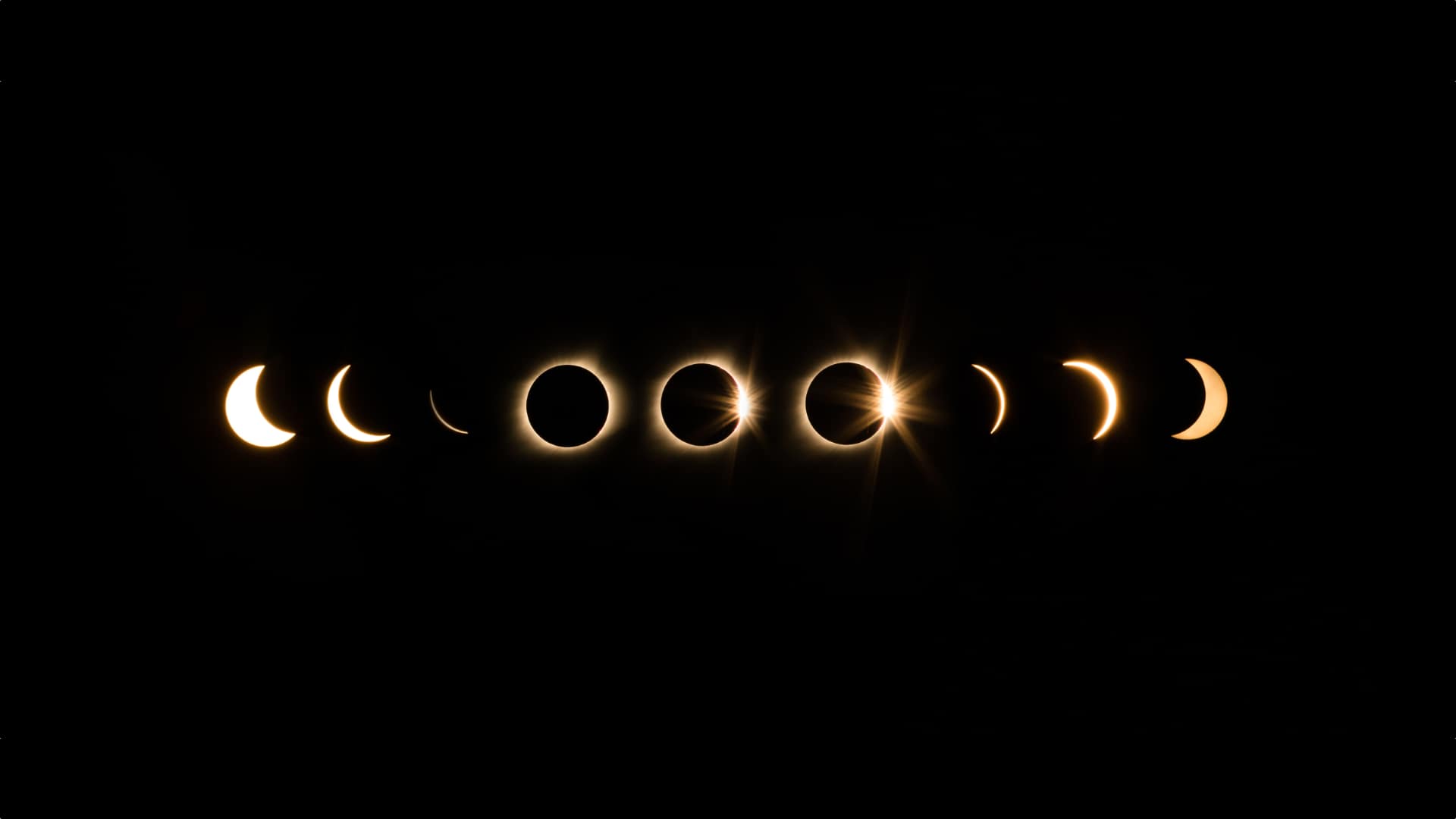
4 minute read

15 million people live in the path of totality of next week's solar eclipse, with nearly a billion on the fringes. Here's the kit, exposure settings and shot sequence for capturing it on any camera.
The Moon takes its next serious bite out of the Sun on 12 August, when a total solar eclipse sweeps across Greenland, Iceland, and Spain. Around 15 million people sit inside the path of totality, and close to a billion more will catch a partial eclipse. For anyone with a camera, a smartphone, or both, it is one of the celestial events genuinely worth planning a shoot around.
Here is what the kit, the settings and the sequence actually require, whether you are shooting on a DSLR or a phone.
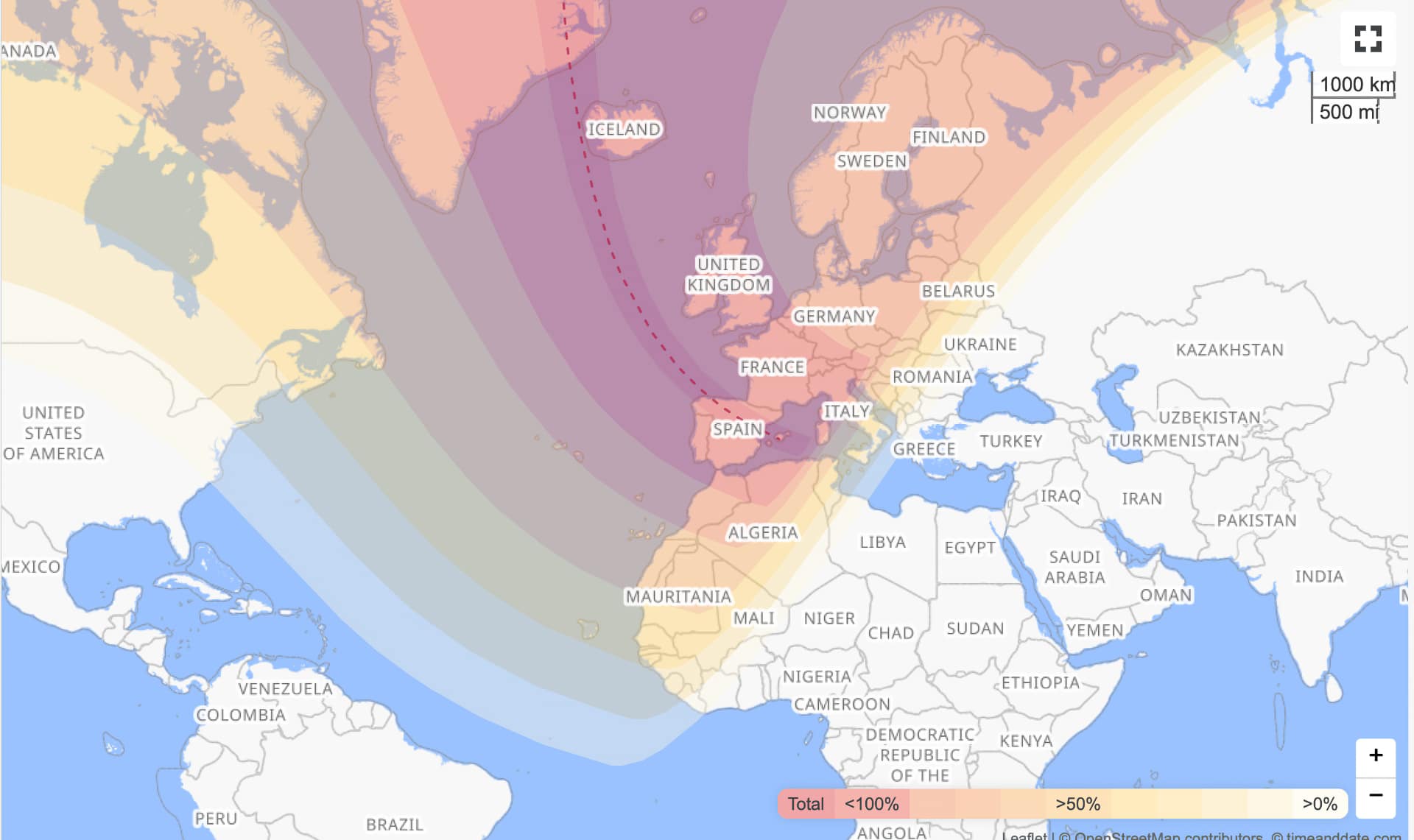 The path of totality and surrounding regions. Pic: timeanddate.com
First the obvious. Bring plenty of charged batteries and memory cards, and a remote shutter release cable so you are not introducing shake by pressing the shutter button directly.
Lens choice is the biggest creative decision. A long focal length fills the frame with the eclipsed Sun but demands constant recentring and cuts you off from the wider scene, including stars, planets and the outer corona. A short, wide-angle lens captures the bigger picture, including the darkened landscape and other eclipse watchers, but renders the Sun itself as little more than a bright dot.
So, two cameras then…
Mount choice usually comes down to what you can carry. A tripod is lighter and easier to transport than an equatorial mount, but needs regular adjustment to keep the target framed. Either works, provided it is stable and quick to reposition under pressure.
One not optional piece of kit is a solar filter. It must be certified, checked beforehand for pinholes that let light through, and fitted securely enough that it will not shift during the partial phases, yet removable quickly for totality and replaceable just as quickly once totality ends. Bring a spare.
Certified eclipse glasses are required for direct viewing throughout the partial phases; only during totality itself is it safe to look at the Sun with the naked eye.
Exposure needs vary sharply across the event, and BBC Sky at Night Magazine's Pete Lawrence offers useful starting points. These should be treated as general guidance rather than fixed values, since local sky conditions affect exposure time:
For the partial phases, shooting through a solar filter (ND5.0), around 1/500 second is a reasonable start. Baily's beads call for roughly 1/4,000 second, the chromosphere around 1/2,000 second, and prominences around 1/1,000 second. Once totality begins and the filter comes off, the inner corona needs exposures from around 1/250 second out to roughly a quarter of a second depending on how far out you are shooting, while the mid to outer corona runs from half a second out to several seconds for the faintest streamers.
Because the dynamic range across the corona is enormous, bracketing exposures during totality and blending them afterwards (Lawrence recommends a layer-masking approach in software such as Photoshop) is standard practice for anyone chasing detail in both the inner corona and the long outer streamers.
For timelapse, a 1-second interval yields about 6.6 seconds of totality in a 24fps cut, a 4-second interval compresses that down to under 2 seconds, which can feel like a jump cut. Most guides land on a 1–2 second interval as the practical middle ground.
Below is a restoration of one of the earliest known films of a solar eclipse, captured on 28 May 1900 by magician, Nevil Maskelyne, while on an expedition by The British Astronomical Association to North Carolina. The YouTube notes state that in 1898 he travelled to India to photograph an eclipse. He succeeded but the film can was stolen on his return journey home.
A total eclipse runs through four contacts. First contact marks the start of the initial partial phase: filter on, exposure set, and the show begins. As the partial phase progresses, this is a good moment for pinhole projection shots, a colander or tea strainer held up to cast a field of tiny crescent Suns onto card or a wall, achievable on a smartphone.
Second contact brings Baily's beads, the diamond ring effect and a brief look at the chromosphere, as the Moon's rugged edge lets the last slivers of sunlight through. The filter comes off just before the first diamond ring appears. Totality itself reveals the corona, prominences, and often stars and planets in a darkened sky; exposure and lens choice here should reflect whether the priority is the inner corona's fine detail or the outer streamers reaching several solar radii into the sky. Solar maximum tends to produce a corona that fans out like flower petals, while solar minimum produces a flatter, more linear shape.
Third contact rather obviously repeats the beads and diamond ring in reverse, and the filter must go back on immediately afterwards. The second partial phase that follows is worth watching for shadow bands, faint rippling waves of light and dark that pass across a plain, light surface such as a white sheet, best caught on video given how subtle they can be. Fourth contact ends the event as full daylight returns.
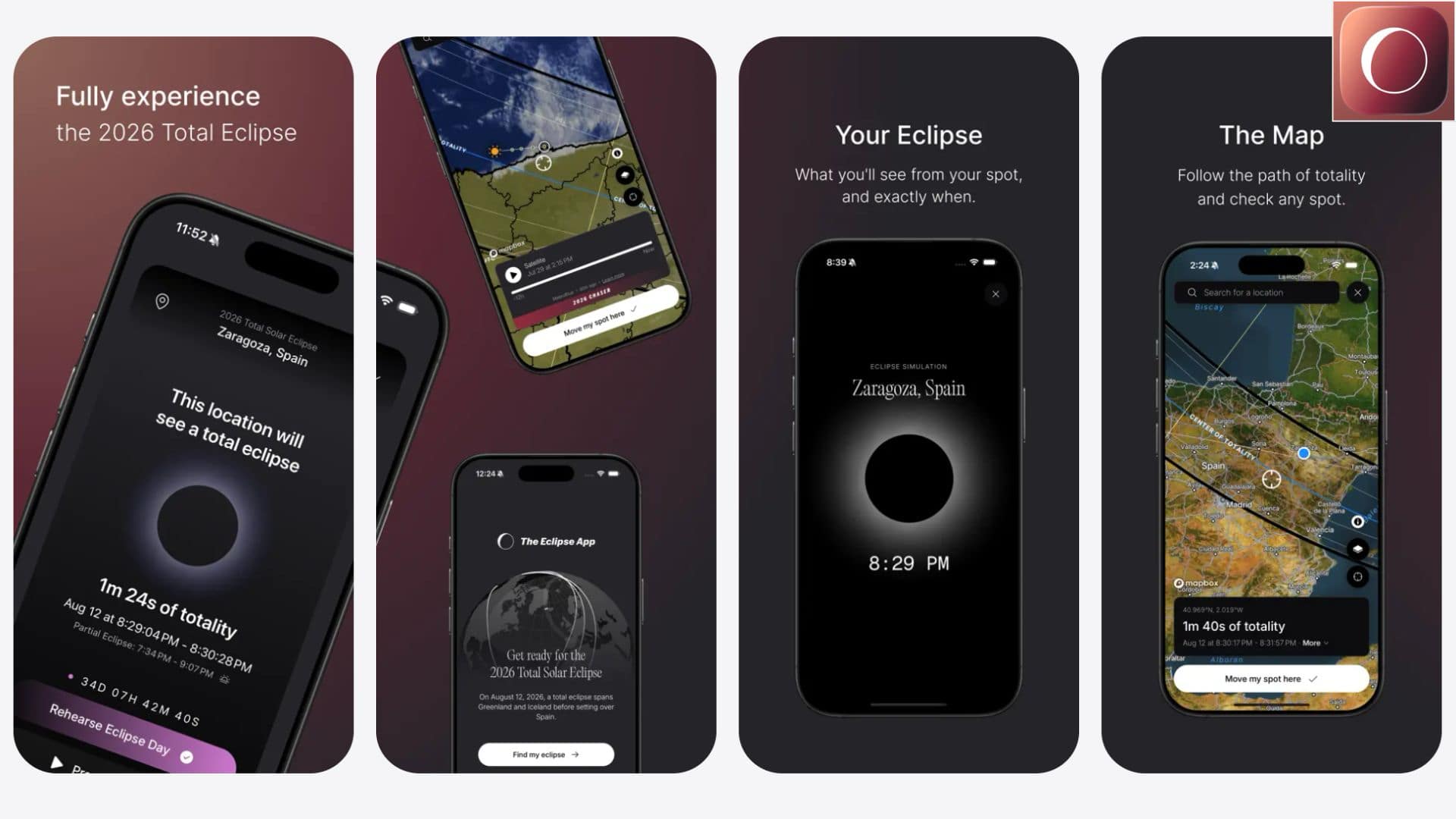 Several apps have been built specifically around this eclipse to help fill the gap. Space.com provides the following list.
SolarWatch (iOS) offers interactive path maps, cloud obscuration data and a 3D simulation of the Moon's shadow crossing the Earth, along with phase countdowns tied to your exact location.
The Eclipse App (iOS) gives precise contact timings and location-specific simulations, and can record the event for playback afterwards.
Totality by Big Kid Science (iOS and Android) adds GPS-based timing, safety guidance and navigation tools for getting into the path if you are not already in it.
Solar Snap (iOS and Android) is built around smartphone photography specifically, pairing with a dedicated filter kit, or a homemade filter from a pair of eclipse glasses, and including its own capture controls and eclipse map.
And if you miss this one, another cracker is on the cards for August 2027, with totality crossing North Africa and through into the Middle East, even clipping the south of Spain once more.
Update: Also check out Umbra, an app built by Steven Madow, a NASA-credentialed launch photographer and official LUMIX creator who specializes in large-scale multi-camera automation and knows a thing or two about photographing space.


RedShark 2020 @ All rights reserved.

Comments