
4 minute read

Featuring Beeble, CETA, Filmsticks, First Rush, Matchmove Machine, and more. From AI search and Donut Labs in trouble, to revisiting color in Manchester, and assessing your cable bandwidth.
 London-based Filmsticks has launched Action! by Filmsticks, a one-piece clapperboard range aimed at independent filmmakers, film schools, etc. The boards combine a UV-printed, wipe-clean acrylic slate permanently bonded to ABS resin clappersticks in a single fixed-piece construction with no modular components. The medium format boards measure 280 mm x 220 mm (11" x 8.66") and weigh 456 g (16 oz). Fields cover scene, slate, take, roll, director, DoP and date, and three layout versions are available: EU, USA and Spain. Priced at £34.95 plus VAT, the range is available now from filmsticks.co.uk and on Amazon.
Matchmove Machine has announced an online database of lens distortion grids aimed at artists, compositors and VFX teams. The resource, at grids.matchmovemachine.com, lets artists search real camera and lens combinations and download prepared distortion grid assets as a practical starting point for production work. Lens distortion data is a small but often overlooked part of the VFX pipeline, and when it is missing or poorly captured, it can slow camera tracking, CG integration and compositing. This is designed to give post teams a single, organized reference rather than relying on scattered per-production captures. Distortion grids are $15 each, while $25 adds lens presets and project files.
The Verge writes that Donut Lab's claims of a mass-production-ready solid-state battery have been exposed as fraud in a 45-minute YouTube investigation by Ryan Inis Hughes on the Ziroth channel. Drawing on a whistleblower and over 20 independent battery experts including researchers from Germany's Fraunhofer Institute, Hughes demonstrates that Donut Lab's "miracle" cell is a standard lithium-ion NMC design. CEO Marko Lehtimäki appears to have paid Finland's VTT research center to run selective tests, creating a veneer of legitimacy while avoiding the two critical claims: 400 Wh/kg energy density and 100,000-cycle life. Donut Lab raised approximately $25 million from over 1,300 mostly small investors and Finland’s authorities are apparently looking into things.
First Rush is a macOS multi-camera SDI recorder built for on-set editors by Jinkyu Han, a working editor in the Korean film and TV industry. Its key trick is SDI REC-flag auto-record, syncing start/stop with the camera so no takes are missed. Up to 16 cameras can be monitored simultaneously, with Scene/Cut/Take metadata entry, ANC timecode, OCR slate reading, and an iPhone/iPad companion viewer. It supports Blackmagic and AJA hardware, records to Apple ProRes, and runs on Apple Silicon. At around $140 per year (a fraction of competing products), Han says it brings professional on-set workflow to freelance budgets. https://editorhan.me/tools/
If you've ever plugged a monitor into your Mac and wondered why you can't get the refresh rate you expected, the answer almost always comes down to cable bandwidth. That means you need the Mac Cable Bandwidth Calculator. This lets you pick a resolution, refresh rate, and cable type, then computes the exact bandwidth required in Gbps. It flags whether your choice fits within HDMI 2.0 or 2.1, DisplayPort 1.4, USB-C DisplayPort Alt Mode, or Thunderbolt 3, 4, or 5, and cross-references it against what your specific Mac silicon (M1 through M5) can actually output. Trying to run 4K 120 Hz, 5K 60 Hz, or 6K? This will tell you whether your cable is the bottleneck or your machine.
Beeble's SwitchX video-to-video AI model is now powering OpenArt VFX, a newly launched platform that brings professional-grade visual effects to everyday creators. The platform lets users replace backgrounds, relight scenes, and apply frame-level VFX edits from a single video upload, with no green screen, no compositing software, no traditional VFX pipeline required. SwitchX handles subject isolation, cinematic relighting, and masked video editing in minutes. The technology addresses what looks to be a genuine gap: most AI video tools focus on generation, not editing footage already shot on a real camera. OpenArt VFX is available now as part of the broader OpenArt platform.
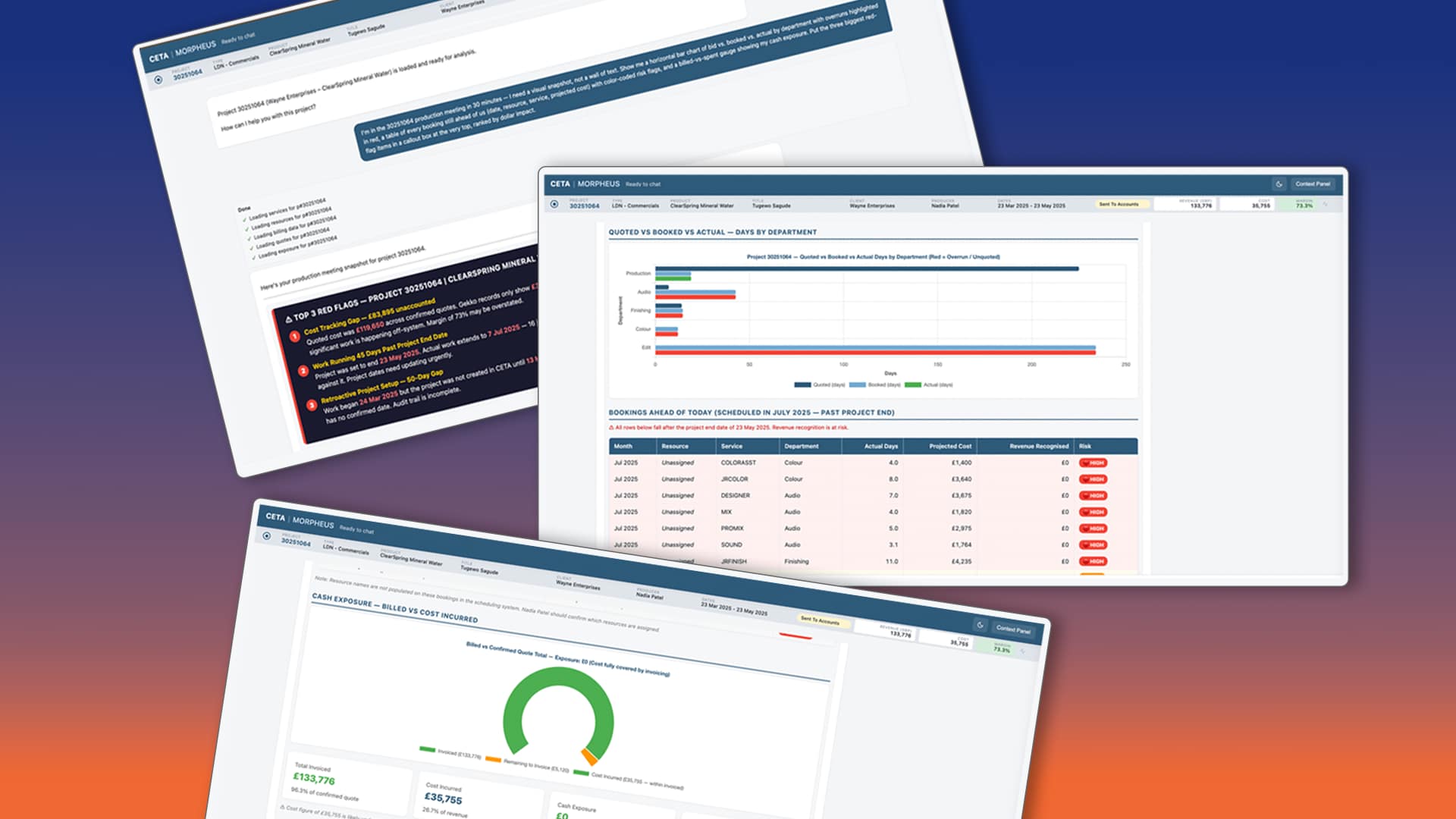 CETA Software has launched Morpheus, an AI-powered reporting tool built into its post-production management platform. Using natural language prompts, users can generate KPIs, charts and tailored reports in seconds, with real-time analysis covering budgets, profit margins, timelines, resources, benchmarking and anomaly detection.
Morpheus supports multiple AI providers including Anthropic Claude, OpenAI ChatGPT, Google Gemini, Microsoft Copilot and local on-premise models via Ollama. The recommended configuration uses Claude's MCP approach, retrieving only the data needed via structured queries for more accurate analysis.
All existing CETA customers receive one complimentary license for a limited period. Wider AI features covering bidding and scheduling workflows are planned.
It’s been a while now since we were up in Manchester for the Manchester Creator Connect 2026 event, so we’re delighted to see Brett Danton’s talk on color consistency make it onto YouTube. Brett approached things from a production standpoint, focusing on how decisions on set translate through to post. This is often an area where problems can creep into productions, so his experience here is always worth a listen.
As Ars Technica writes, a German court has ruled Google liable for false statements made in its AI Overviews. The Munich court found that, unlike traditional search engines which surface links to third-party content, Google's AI Overview makes "independent, new, and substantive statements" of its own. The case was brought by two publishers whose work was incorrectly associated with scams by AI-generated summaries.
Google's argument that users know AI outputs aren't reliable backfired: the court noted that AI Overviews would be pointless if users had to verify every result. Crucially, the ruling notes that AI summarization is an optional add-on, not a core search function, meaning firms can't claim the same protections as traditional search engines. With AI Overviews reportedly inaccurate around 9% of the time, and source links wrong 56% of the time, there might be a fair degree of entertainment ahead with this one.
Tags: Post & VFX Production


RedShark 2020 @ All rights reserved.

Comments