3 minute read

ASUS Republic of Gamers marked its 20th anniversary at CES 2026 with a broad set of announcements spanning laptops, desktops, displays, peripherals, and experimental hardware.
Rather than focusing on a single headline product, ASUS' gaming-focused brand ROG used the show to refresh much of its gaming lineup while continuing its push into OLED displays, AI-accelerated workflows, and more unusual form factors.
While ROG remains primarily a gaming brand, many of the updates clearly target creators working across video, streaming, and hybrid production setups. Here are some of the highlights. As ever with CES, pricing and availability for many of these products will follow later in the year.
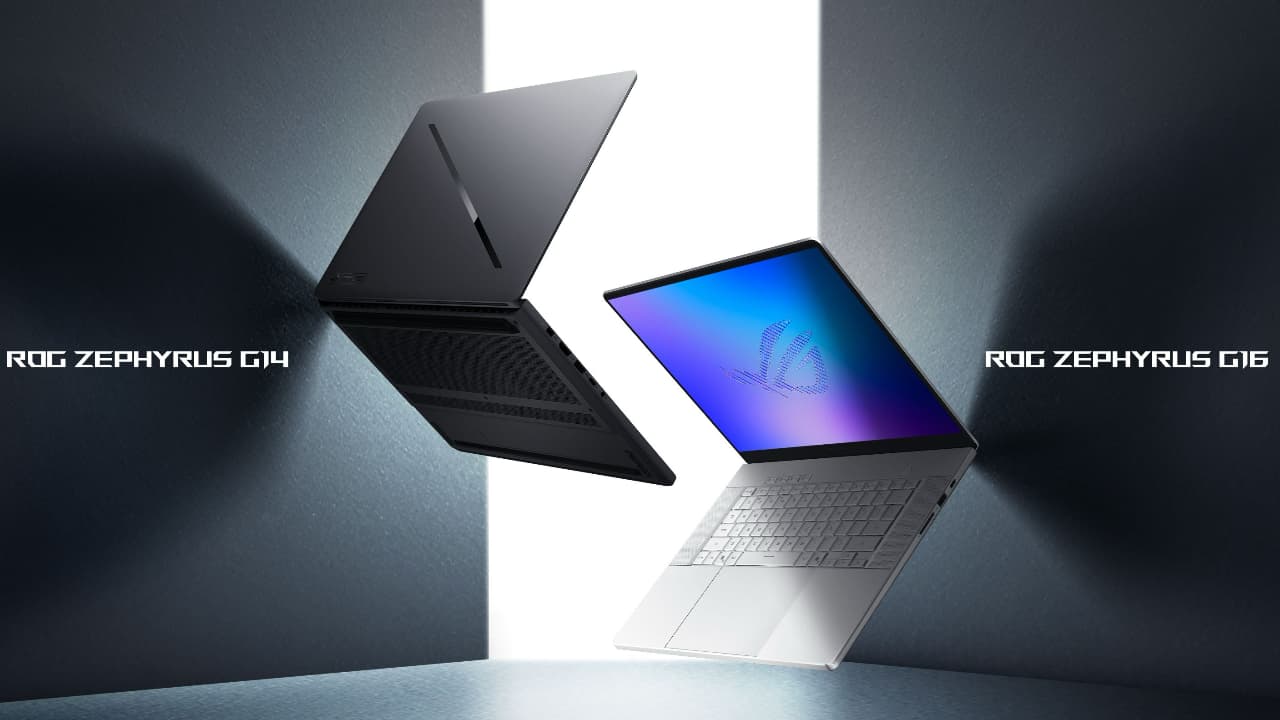 The latest Zephyrus G14 and G16 models continue ASUS’s thin-and-light performance approach, pairing current-generation CPUs with NVIDIA RTX 50-series laptop GPUs. There is increased emphasis on system-level AI acceleration, with 50 TOPS of NPU performance and Copilot+ designed to support local AI tasks alongside gaming and creative workloads.
Both models feature 1100 nit HDR OLED displays that provide 100% DCI-P3 coverage and Delta E < 1 color accuracy for cinema-grade quality, continuing a trend that has seen OLED move from premium niche to largely mainstream across gaming laptops. For creators, the benefits are familiar: higher contrast, deeper blacks, and more consistent color reproduction than traditional LCD panels, particularly when working in darker environments.

ASUS also refreshed the Zephyrus Duo, which maintains its dual-screen design using two 16-inch 120Hz OLED touch displays. The second screen is aimed at multitasking-heavy workflows such as streaming control panels, timelines, chat windows, or secondary tools alongside games or creative software. As with previous Duo models, it’s a niche product, but one that clearly targets users who actively benefit from multi-display setups.
On the desktop side, ROG revealed the G1000 gaming PC, notable for introducing what ASUS describes as the world’s first AniMe Holo holographic fan system. The fans project animated visuals while still functioning as part of the cooling system.
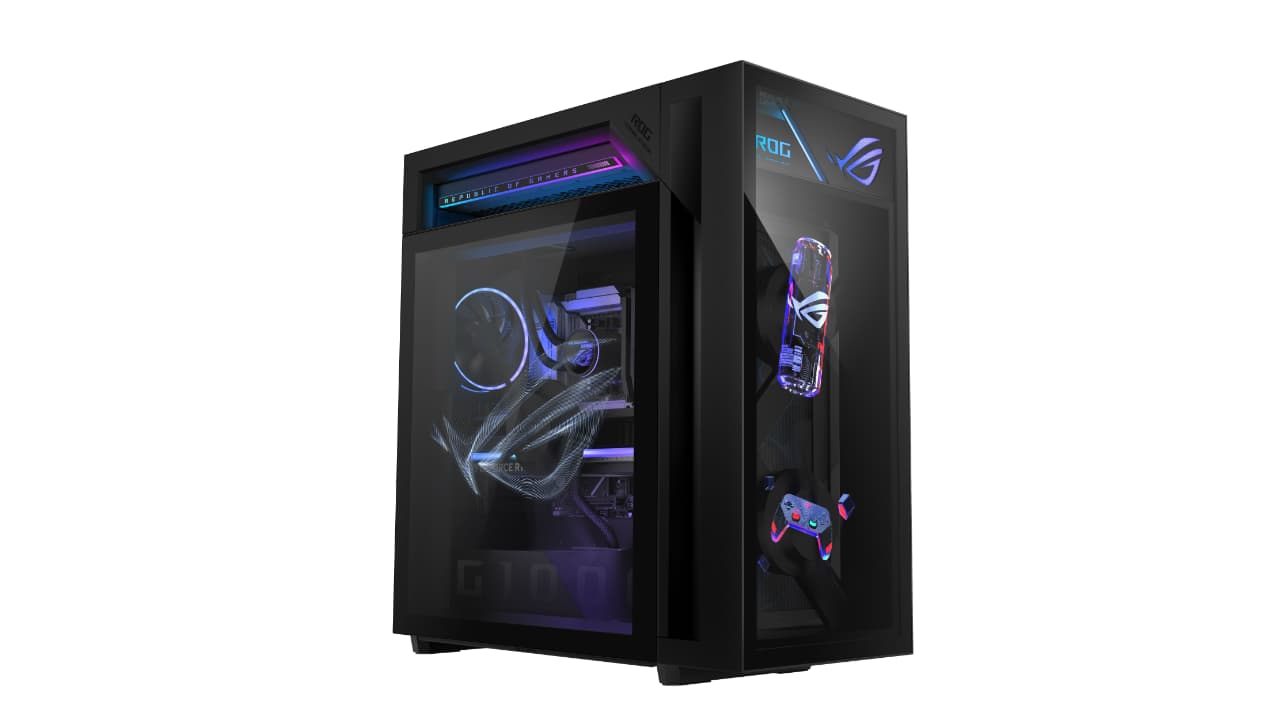
Okay, it’s an aesthetic feature rather than a performance one, but it underlines how ROG continues to blend visual customisation with traditional gaming hardware design. The system supports high-end discrete GPUs and is positioned as a flagship desktop offering.
ROG’s push into OLED gaming displays continues with new RGB Stripe Pixel OLED monitors, including the Swift OLED PG27UCWM and PG34WCDN. The RGB stripe layout is designed to improve text clarity and edge sharpness, addressing some of the common complaints around earlier OLED monitor generations.
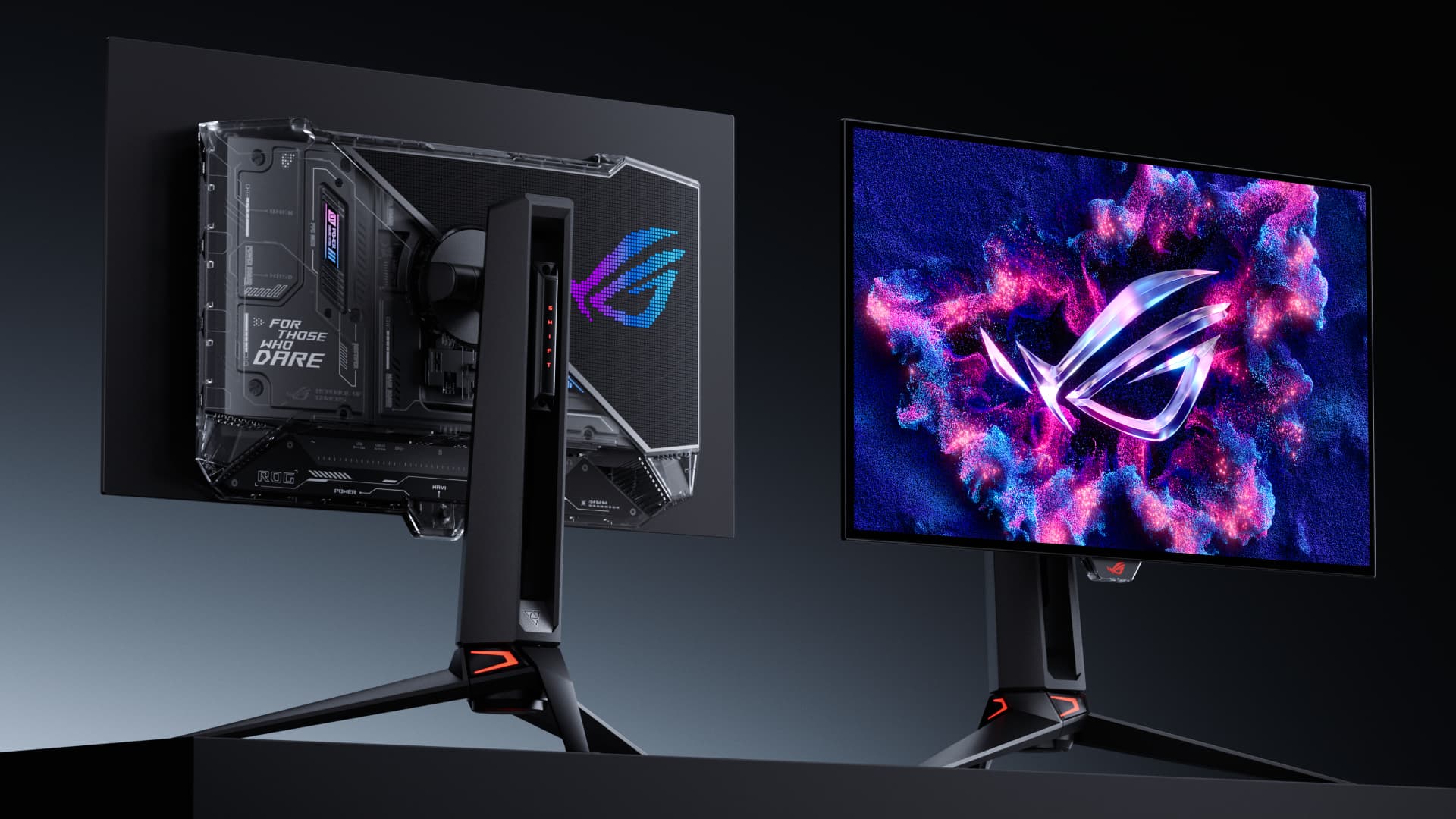
The PG27UCWM features a 26.5-inch 4K Tandem RGB OLED panel with dual modes of 4K240Hz or FHD480Hz and a 0.03ms response time. RGB Stripe Pixel technology to deliver up to 27% larger color volume, especially at high luminance levels, giving gamers richer, more vibrant colors. RGB stripe pixel OLED technology guarantees sharp text edges and high-fidelity color reproduction, 99% DCI-P3 gamut, true 10-bit color, Delta E < 2, and Dolby Vision support.
The ROG Swift OLED PG34WCDN expands experiences with a 34-inch WQHD (3440x1440) QD-OLED curved panel at 1800R, featuring a semi-glossy surface, 360Hz refresh rate, and an ultrafast 0.03ms GTG response time. It also employs the world’s first RGB stripe OLED technology ensuring precise colors and sharp visuals across all content.
ROG BlackShield film increases the panel’s hardness for 2.5-times better scratch resistance versus previous QD-OLED panels, so users don’t have to worry about scratching the display during cleaning. Plus, the film boosts perceived black levels by up to 40%, delivering deeper black hues and exceptional contrast, even in bright environments.
Additionally, it offers VESA DisplayHDR 500 True Black, 99% DCI-P3 coverage, 10-bit color, and Delta E < 2.
Among the more experimental products was the ROG XREAL R1, developed in partnership with XREAL. These AR gaming glasses use a 240 Hz micro-OLED display with a 57-degree field of view, designed to create a large virtual screen when connected to a PC, console, or handheld device via the ROG Control Dock. In effect, users can enjoy a 171-inch virtual screen at 4 meters when wearing them.
While still a niche category, AR displays continue to evolve as potential alternatives to traditional monitors for portable setups.
The CES 2026 announcements coincide with ROG’s 20th anniversary, marking two decades since the brand’s first gaming motherboard launched in 2006. AR displays in particular will be an interesting category to track over the next 20 years
Tags: Technology CES 2026 ROG


RedShark 2020 @ All rights reserved.

Comments