6 minute read

NASA's Artemis II is using laser communications to beam live video from beyond the Moon. Here's how the broadcast pipeline actually works, and what viewers will really see.
When Neil Armstrong set foot on the Moon in July 1969, the world watched on televisions that struggled to make sense of what they were seeing. The footage was ghostly, washed-out, and barely resolved — a product of the brutal constraints of getting any video signal across 240,000 miles of space with 1960s technology.
As we went into in some detail in Did someone wipe the moon landing tapes?, the actual picture that got back to the receiving stations on Earth wasn't that bad. A special camera mounted inside the door of the module developed by Baltimore's Westinghouse Electric Corporation used a non-standard scan format of 10 frames per second and a 320 line resolution. It wasn't great compared with the (then) US television standard of 30 frames per second and 525 lines, but according to those that saw it come in, it was pretty good. The signal degradation really came into play on the hops from there, and the mix of microwave links, communications satellites, and analogue phone landlines that got the signal back to Mission Control in Houston.
Engineers at the tracking stations were meant to tape the original telemetry, including the video signal, onto one-inch magnetic tapes for backup. That way the rest of the world would eventually have seen the pictures as they were when they hit Earth. The tapes were lost though. Read the link for more, it's a good tale.
Anyway, for Artemis II launched on April 1, 2026, carrying four astronauts on the first crewed lunar mission in over 50 years, NASA is promising something very different on the broadcast side: live video from lunar distance, with the capability at least to transmit 4K.
Throughout the mission, Orion is running two parallel comms systems simultaneously. The primary link is NASA's Deep Space Network, which takes over from the Near Space Network after the mission leaves Earth orbit. This is the veteran array of radio antenna complexes in California, Spain, and Australia that has been the backbone of deep space communications since the Apollo era. It provides an almost continuous S-band radio connection to Earth and handles all mission-critical data. Nothing about that changes.
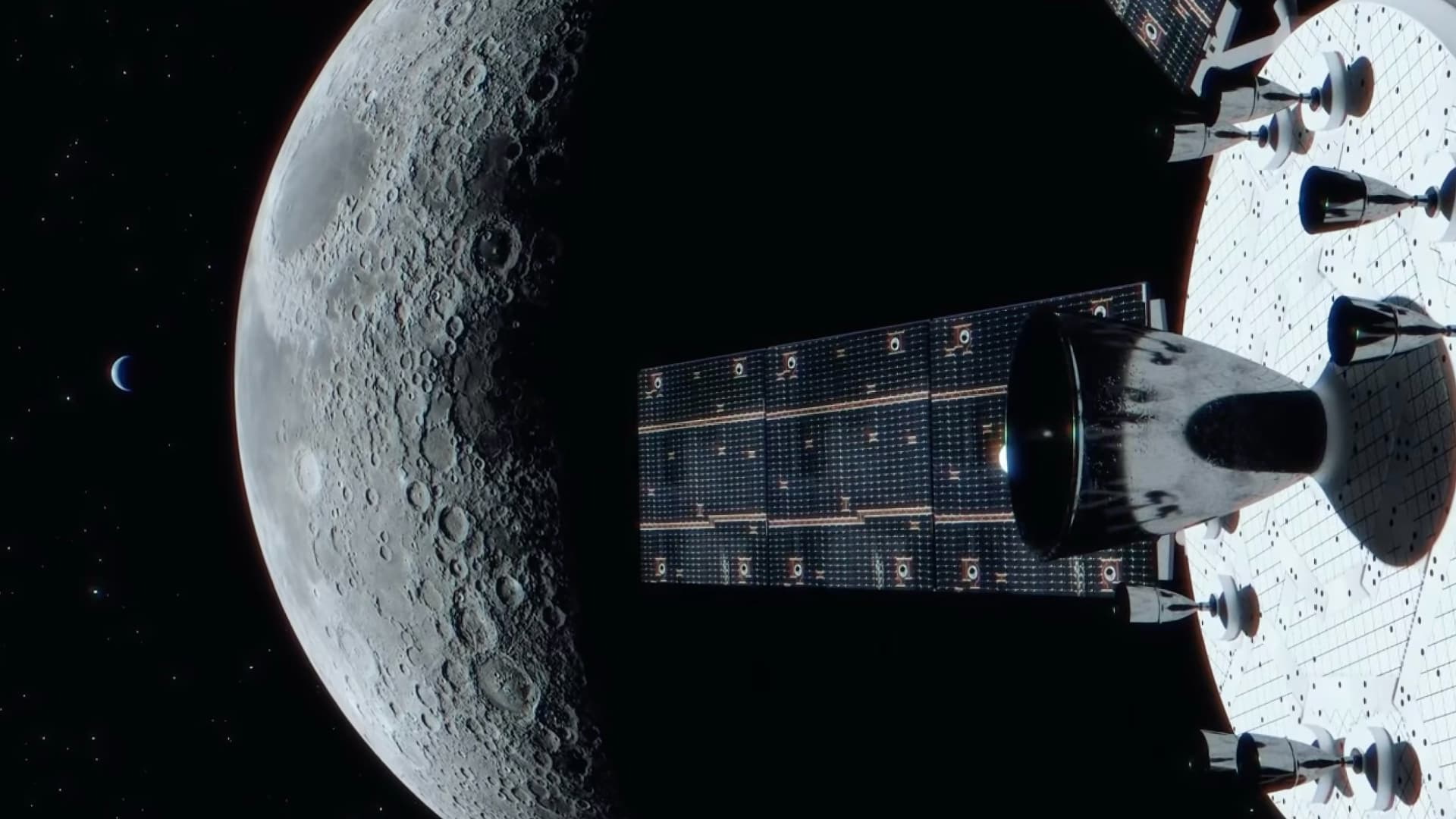
What's new, and what's under active evaluation, is the Orion Artemis II Optical Communications System, known as O2O. This is a laser-based communications terminal mounted on Orion's crew module adapter, which is running in parallel with the DSN periodically throughout the 10-day mission.
O2O is officially classified as a Detailed Test Objective: NASA is assessing its operational utility in a real crewed deep-space environment, not relying on it for anything mission-critical. Think of it as the DSN being the safety net. O2O is the future, being tested carefully against the present, where you can imagine NASA hopes their roles will eventually swap.
O2O is built around a component called MAScOT — the Modular, Agile, Scalable Optical Terminal — developed by MIT Lincoln Laboratory. Roughly the size of a cat, it consists of a 4-inch telescope mounted on a two-axis gimbal, with fixed backend optics and a modem that converts mission data into laser pulses and back again. A controller handles pointing, interfaces with Orion's flight avionics, and keeps the beam locked on its targets on Earth.
The system uses near-infrared laser light rather than radio waves. The fundamental advantage here is bandwidth: infrared light operates at a much higher frequency than radio, allowing it to carry significantly more data per unit of time. It also produces a tighter, more focused beam, which means less energy waste, and a smaller, lighter terminal for the spacecraft.
This isn't a brand-new idea arriving untested on a crewed mission. O2O is the product of a decade-plus development lineage running through the Lunar Laser Communications Demonstration in 2013, the Laser Communications Relay Demonstration in 2021, and the ILLUMA-T terminal that flew to the International Space Station in 2023. Each step proved out the core technology in progressively more demanding environments.
O2O, though, is the first time it's going beyond low Earth orbit, and the first time it's on a crewed vehicle. Which is kind of inevitable given that it's the first time a crewed vehicle has broken out of orbit for over half a century.
The headline data rate for O2O is 260 Mbps downlink. This is enough, as project manager Steve Horowitz has confirmed, to transmit 4K video from the Moon. However it is very much a peak figure. The nominal operating rate is 80 Mbps, and the planned concept of operations specifies a minimum of one hour of laser link per day throughout the mission.
Even at that constrained schedule, the numbers are striking: using one hour of laser link per day, Orion can downlink around 36 GB of data — roughly six times what the DSN's S-band connection would manage in the same period. The uplink rate, for commands and data sent from Earth to Orion, meanwhile, is up to 20 Mbps.
As of April 4, way before lunar turnaround, NASA confirmed that over 100 GB of data has been transmitted via O2O. And yes, the Hello World picture was part of that data.
 As long as there is line of sight, O2O can handle greater data bandwidths than previous systems
Orion carries two distinct camera systems, and they feed into the broadcast pipeline in very different ways. The fixed camera system — 11 internal and external cameras supplied by Redwire Corporation — records 4K video and 12 MP stills, and is designed for continuous streaming of both the spacecraft interior and exterior. These are the cameras most likely to be the source of any live video transmitted via O2O to the ground and onward to the public.
The Nikon D5 handheld cameras used by the crew are a different matter. Video from the D5s can be routed through Orion's onboard ZCube encoder, a Z3 Technology unit that accepts 3G-SDI input at up to 60 frames per second and encodes to H.265 or H.264 before packetising the output over Ethernet. That Ethernet stream is what feeds into the O2O pipeline.
However, NASA's own Orion Imagery Working Group planning document recommends keeping D5 in-flight video downlinks to 1080p or 720p. Large 4K and UHD files from the D5s will most likely wait for physical retrieval after splashdown. NASA is looking at 4K D5 footage, and presumably 4K Z9 footage now as well as one snuck onboard at the last moment, to be a post-mission asset, not a live broadcast source.
Crucially, what NASA has actually specified for real-time video over O2O is more conservative than the 4K capability figure suggests. The official operations concept confirms that O2O will be used to provide real-time SD and HD video to mission control, not 4K. The system is capable of 4K at peak throughput, but that bandwidth is shared across all mission data: telemetry, flight plans, scientific data, file transfers, and voice. In practice, live video over O2O means HD at best during normal operations, with true 4K content more likely to return to Earth on CompactFlash cards after splashdown.
NASA has confirmed that for Artemis II, data arriving from Orion will be compressed after it reaches Earth to manage the volume of information, with priority given to crew voice communications and mission-critical data. Image and video quality will take the hit. Future Artemis missions will upgrade those ground processing systems, with NASA explicitly citing improved image and video clarity as a goal. But for this flight, the compression pipeline is another layer between O2O's raw capability and what any viewer eventually sees.
Weather dependent
That, however, is not totally up to NASA as the weather needs to be onboard too. O2O transmits to one of two ground receiving stations: NASA's White Sands Complex in Las Cruces, New Mexico, or JPL's Table Mountain Facility in Wrightwood, California.
Both were selected for minimal cloud cover, because cloud cover is the laser's enemy. Unlike radio waves, an infrared laser beam cannot punch through significant cloud. Having two stations provides geographic redundancy, but neither is immune to weather. The quality of any video received through O2O is partly a function of what the sky looks like in New Mexico or California at the moment of transmission.
There is one constraint no amount of engineering solves: Orion will pass behind the Moon and, without relays in place, it goes dark as far as comms goes.
That means for approximately 41 minutes, Orion loses line-of-sight to Earth entirely, taking both the DSN and O2O links dark simultaneously. This is a planned blackout, baked into the mission trajectory, and it coincides with the most dramatic part of the mission — the lunar far-side pass. When Orion re-emerges, the Deep Space Network reacquires the signal first, followed by O2O re-establishing its laser lock.
NASA is already working to eliminate the blackout problem entirely, with Intuitive Machines selected in 2024 to develop lunar relay satellites for demonstration during future missions.
O2O is currently not slated to fly on either Artemis III, recently rejigged as a low Earth orbit rendezvous test, nor is it planned for Artemis IV, the revised first crewed lunar landing mission currently scheduled for 2028. This mission is explicitly a proof-of-concept, and NASA is not rushing the transition. The Deep Space Network is not going anywhere.
But Artemis II represents something genuinely significant: the first operational test of laser communications on a crewed vehicle beyond low Earth orbit, running side by side with the system it is designed to eventually supplement.
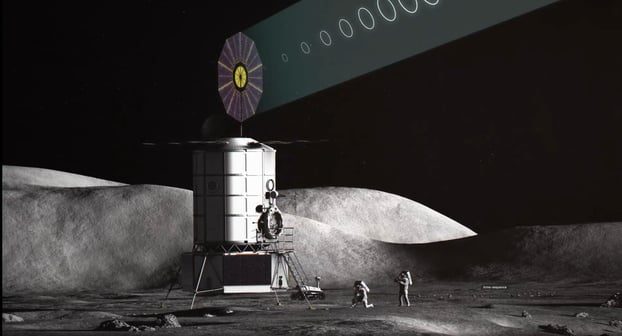 A step towards sustained lunar presence. Pic: NASA
If O2O performs as hoped, it establishes the communications model for sustained human presence on the Moon — and eventually, for missions to Mars, where data latency and bandwidth constraints become far more acute than anything the lunar programme faces.
There's also a demonstration running in parallel with the Australian National University at the Mount Stromlo Observatory, where researchers will attempt to receive O2O's laser link using commercial off-the-shelf hardware. If that works, it suggests future ground infrastructure for laser comms doesn't need to be bespoke NASA kit. Which, when you're using a laser the size of a cat pointed at a patch of desert in New Mexico to carry live video from a quarter of a million miles away, is not bad going.
Tags: Production Space NASA Artemis


RedShark 2020 @ All rights reserved.

Comments