
3 minute read
Advertisement
Christopher Nolan's The Odyssey is the first feature ever shot entirely on IMAX film cameras, and released in six formats on July 17 to the biggest opening of his career to date. Here's what each format actually looks like and whether it's worth seeking out.
Updated July 19, 2026: The Odyssey has now opened, taking $120.5 million domestically and $257.8 million worldwide over its opening weekend. This is the biggest launch of Nolan's career, ahead of The Dark Knight Rises, The Dark Knight, and Oppenheimer. The reviews are pretty stellar too.
Christopher Nolan’s The Odyssey opened on July 17 and, as everyone knows, the director’s favored format for everyone to watch it in is IMAX 15-perf/70mm. However, there are only around 40 screens capable of showing that worldwide and a limited number of tickets available. Indeed, there are reports of tickets changing hands for silly amounts of money on eBay, and IMAX 70mm showtimes reportedly sold out a year in advance. Amidst the introduction of 7am and even 2am showings, early figures suggest that 70mm screens accounted for around 5% of Thursday preview gross despite the limited availability.
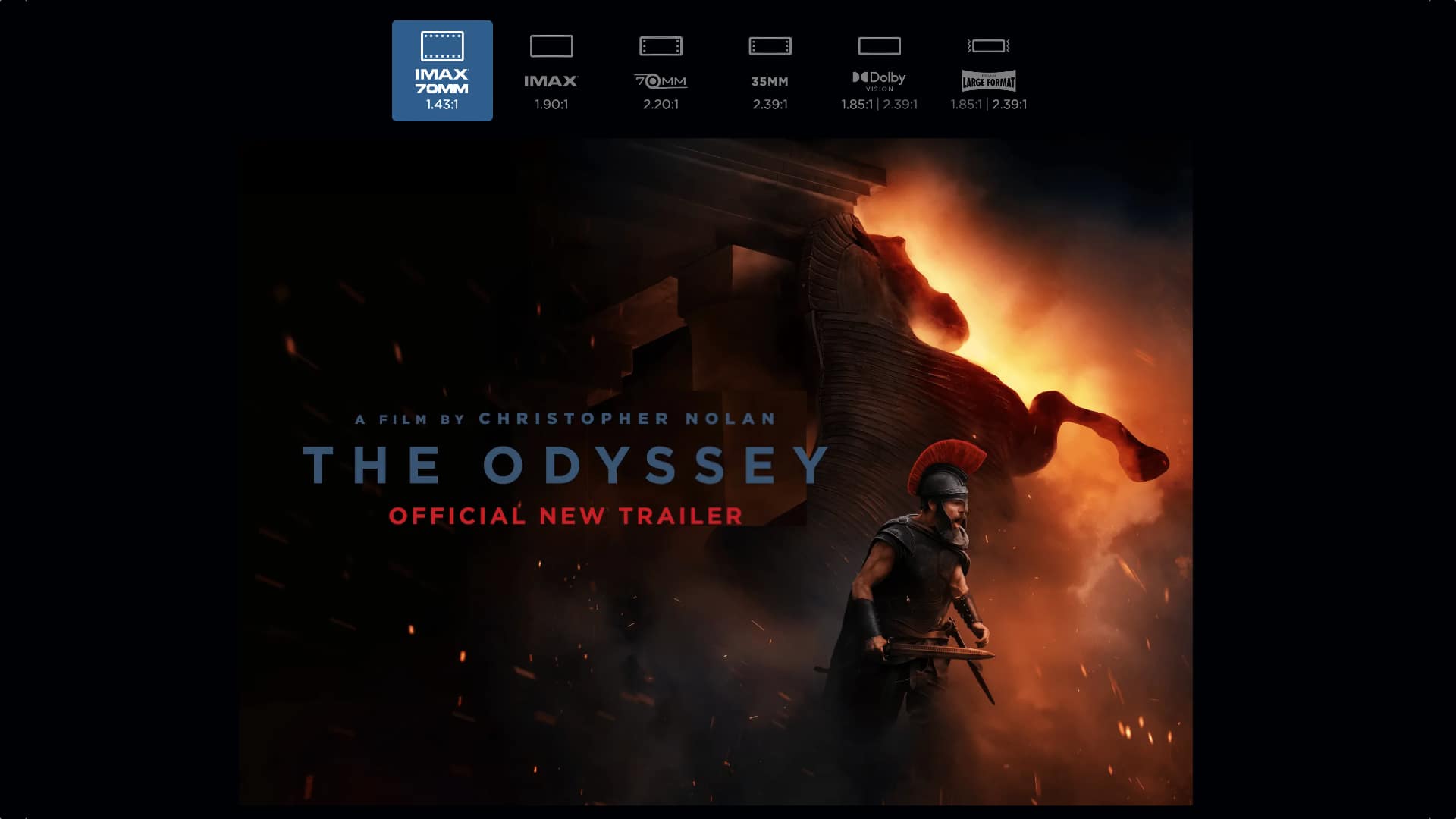
So, there are two interrelated questions here as a result. First, which format should you watch The Odyssey in? Second, if that's not practical due to small factors such as geography, which format can you watch it in and still get at least some of that essential 70mm experience? To help answer both, Universal Pictures has put together a useful interactive page at odysseymovie.com that lets you watch the trailer reframed for each format, so you can see exactly how much the picture changes depending on what format you can get in front of.
And then it has the stars of the movie give a brief explanation of each format. Which, all in all, is a pretty neat idea.
Here’s the breakdown of what each format actually means, from Nolan’s preferred gold-standard IMAX 70mm down to Premium Large Format digital. And yes, this list is probably in order of (his) preference.
IMAX 70mm is the largest, highest-resolution format available for theatrical exhibition, and The Odyssey was made for it. The film runs horizontally through the projector on 15-perf stock, and is shown at a 1.43:1 aspect ratio, meaning the image expands to fill IMAX's signature floor-to-ceiling screen. This makes it genuinely immersive in a way that no other format matches.
There are very few screens globally though, so check to see whether your local IMAX qualifies rather than assuming it does. As a rough guide, if it has tickets available for the movie, it probably doesn’t.
Most IMAX locations are digital rather than film, and the current premium tier is IMAX with Laser. The Odyssey will play in these venues entirely at 1.90:1, with select IMAX with Laser locations capable of showing it at the 1.43:1 expanded ratio. IMAX combines custom theater design with proprietary picture and sound technology, and even at 1.90:1 the film fills your entire field of vision on the floor-to-ceiling screen.
The fact that the entire picture was shot on IMAX Film Cameras means that even in a laser-digital IMAX the source material is as large and detailed as it gets.
Confused yet? Standard 70mm (not IMAX) has been seeing a quiet revival in recent years, with a handful of venues bringing their projectors back into service. At five perforations running vertically through the projector, 70mm film delivers up to three times the resolution of standard digital projection, with the rich analog color that only comes from light passing through celluloid. The aspect ratio is 2.20:1, noticeably wider than IMAX but still a significant step up from any digital format.
The upshot is that if you have a 70mm venue within reach and can't get to an IMAX 70mm screen, this is the next best thing.
The classic format that generations have grown up with. Four perforations, vertical transport, 2.39:1 CinemaScope ratio. It is perhaps a bit counterintuitive that a film shot on IMAX cameras would lose the least in a 35mm print compared to a standard digital exhibition, but that is exactly what happens as the enormous negative gives the optical print team something substantial to work from.
The Dolby Vision laser projection system delivers a 1,000,000:1 contrast ratio alongside exceptional brightness and color accuracy. These are precisely the sort of specifications that matter when the source material was captured on large-format film. Your local Dolby Cinema will show The Odyssey in whichever aspect ratio the screen is configured for, whether that be: 2.39:1 CinemaScope or 1.85:1 Flat. In all cases though, you will be getting the maximum picture that the screen can deliver.
Dolby Atmos audio is included, which is not a minor point for a Nolan film.
PLF is a bit of a catch-all category covering enhanced auditoriums from various cinema chains that includes larger wall-to-wall screens, laser projection, and improved sound, all of which is offered at premium prices. It is a step up from standard digital, though the specific setup varies significantly by venue. The film will be presented in either 2.39:1 or 1.85:1 depending on the screen.
If none of the film formats are accessible to you and there is no Dolby Cinema locally, a PLF screen is likely still a meaningful upgrade over a standard multiplex auditorium. The seats should be better too.
Tags: Production IMAX The Odyssey 70mm

Written by Andy Stout
Advertisement
Advertisement
Advertisement
Advertisement
Advertisement
RedShark is a multiplatform online publication for anyone with an interest in moving image technology and craft. With over 50 contributors worldwide, full-time developers, editorial, sales and marketing staff, it is the go-to site for informed opinion and know-how for the quickly changing video, film and content creation industries.

RedShark 2020 @ All rights reserved.

Comments