8 minute read

The much-anticipated Sony FX5 brings Open Gate recording, internal X-OCN RAW, and three base ISOs to a compact Cinema Line body priced from $4999 arriving in August. A mini-VENICE indeed.
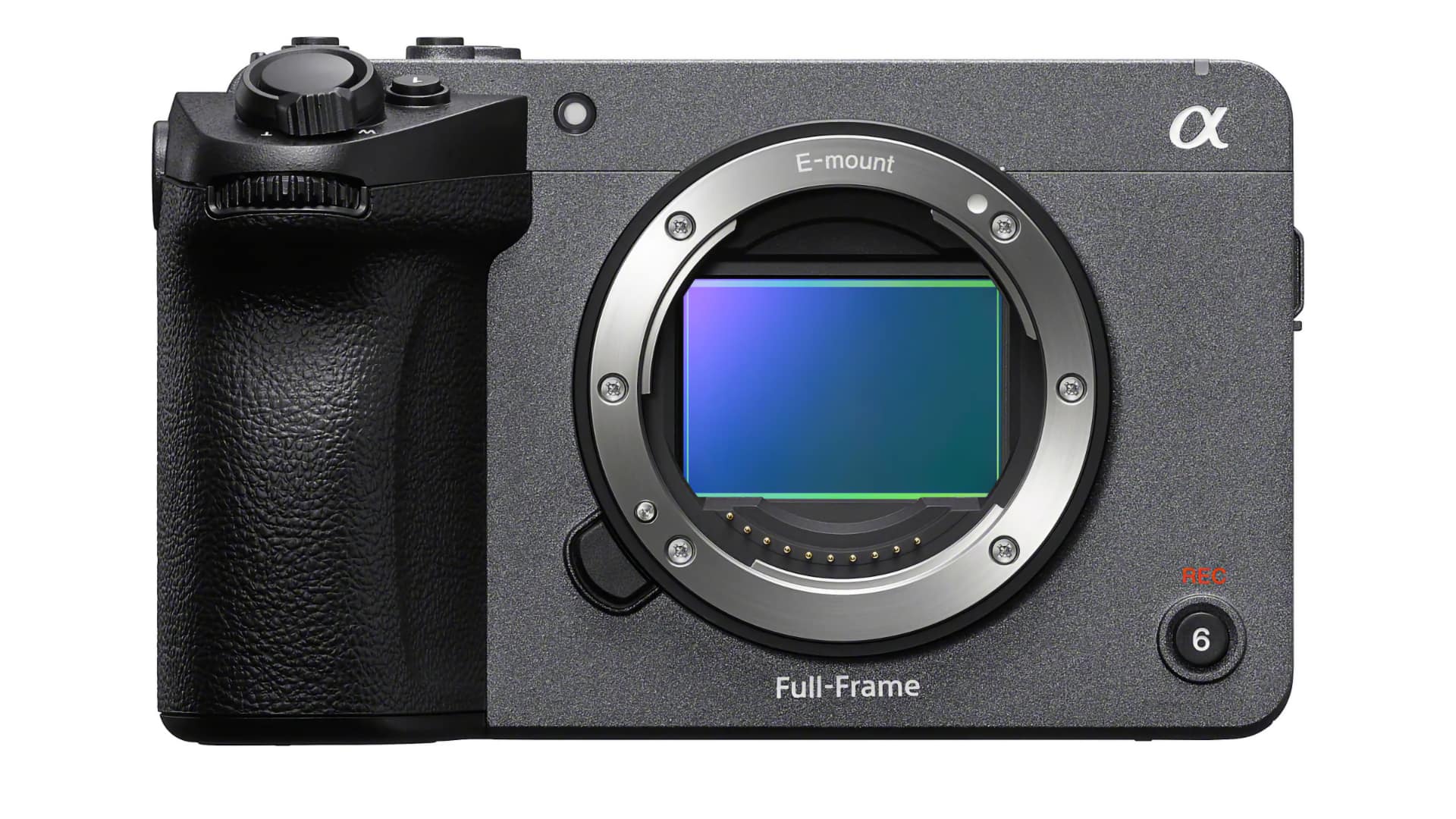
As widely trailed, Sony has announced the FX5, a new Cinema Line camera that slots in between the FX3 and the FX6. Despite sharing most of its footprint and control layout with the FX3, Sony is explicit that the new model is not a Mark II and borrows more from VENICE 2 and BURANO than from the Alpha range it visually resembles. Hence the wholly new name.
Sony's Cinema Line now runs, in ascending order, FX2, FX30, FX3, the new FX5, FX6, BURANO, and tops off with the VENICE 2, with the FR7 remote PTZ camera sitting alongside. Sony frames the FX5 as something for filmmakers and production houses to step up to from the FX3, or as a lightweight B or C camera for car and drone rigs or tight spaces working alongside the BURANO and VENICE 2.
Moving up from the FX3, the FX5 offers Open Gate recording, internal X-OCN raw, three base ISOs, and Dual Gain Shooting. Against the FX6, it lacks the built-in variable ND filter, SDI support, and box-camera form factor and associated ease of rigging.
At the core of the FX5 is a new 16.6-megapixel full-frame, fully-stacked Exmor RS CMOS sensor. It pairs with the latest BIONZ XR2 processor, which includes a dedicated AI processing unit. Sony says the integration improves image quality, subject recognition, connectivity and general operability. The BIONZ XR2 also appears in recent Alpha cameras, though the FX5's 16.6-megapixel sensor is unique to this camera rather than shared with any Alpha model.
For the first time in the FX series, the FX5 supports 3:2 full-pixel readout across the entire sensor, or Open Gate shooting, alongside a range of other scan modes including 17:9, 16:9 and Super 35mm. This gives editors the full sensor area to reframe in post without a resolution penalty, whether that's for anamorphic de-squeeze, a wider aspect ratio, or a vertical crop. Open Gate is currently available only when recording in X-OCN.
At launch, the FX5 is capable of shooting 5K at up to 60fps, 4K at up to 120fps, and FHD at up to 240fps. Faster HFR modes are coming later via firmware (see Firmware roadmap, below).
The available imager modes are full-frame Open Gate 3:2 at 4992 x 3328, full-frame 16:9 at 4992 x 2808, full-frame 17:9 at 4992 x 2632, full-frame crop 16:9 at 4552 x 2560, full-frame crop 17:9 at 4552 x 2400, full-frame crop 16:9 at 3840 x 2160, and Super 35 16:9 at 3264 x 1836.
Anamorphic de-squeeze support has also been extended: the FX5 adds a 1.8x ratio alongside the existing 1.3x, 1.5x, 1.6x and 2.0x options carried over from the FX3, widening the range of anamorphic lenses that can be monitored accurately in real time.
The FX5 also features internal X-OCN recording, Sony's proprietary 16-bit scene-linear RAW format, previously available only on VENICE 2 and BURANO. Sony's stated benefits are high-quality recording without an external recorder, a lighter overall rig, and no risk of an external recorder overheating or shutting down mid-shoot.
The FX5 supports the existing X-OCN LT codec plus two newly developed, more heavily compressed variants, C1 and C2, both of which still record 16-bit images but in smaller files. Sony says this reduces both storage requirements and file transfer times, helping streamline post-production workflows. X-OCN XT and ST, the least compressed variants used on VENICE 2, are not supported on the FX5.
For reference, at 4096 x 2160 24p, Sony's own bitrate comparison puts X-OCN LT at 389 Mbps, the new C1 at a theoretical 289 Mbps, and C2 at a theoretical 232 Mbps (these two are theoretical because no current X-OCN C1/C2-compatible camera actually shoots that exact frame size). For comparison, XAVC S-I 4K sits at 240 Mbps, ProRes 422 HQ at 754 Mbps and ProRes 4444 at 1131 Mbps. Sony also argues X-OCN gives more post-production grading flexibility than 10-bit or 12-bit ProRes.
Operation with X-OCN is only guaranteed using CFexpress Type A VPG400 cards. Alongside X-OCN, the FX5 also supports XAVC HS-L422, XAVC HS-L420, XAVC S-I, XAVC S-L422 and XAVC S-L420, with availability varying by imager mode.
Also see the v2 firmware note below.
When shooting in S-Log3, the FX5 achieves 15+ stops of dynamic range. The FX5 moves from the FX3's two base ISOs (800 and 12,800) to three: 800, 4000 and 12,800, adding the middle option that Sony says filmmakers had specifically asked for to bridge the gap between the two extremes.
Dual Gain Shooting, supported for the first time in the FX series, takes a double readout of the sensor to reduce noise in the shadows without compromising shadow detail, extending latitude further. Gain in this mode is limited to the equivalent of 18dB, and the function may not be available depending on other shooting settings.
At launch, the FX5's headline frame rates are 5K at up to 60fps, 4K at up to 120fps, and FHD at up to 240fps. Faster HFR modes, including 5x slow motion in 5K and 10x slow motion in 4K, arrive with the version 2.0 firmware update rather than at launch (see Firmware roadmap, below).
Again, see the v2 firmware note below.
Sony describes the design as a compact, lightweight body with a flat-top design, flexibly supporting handheld shooting, gimbal operation and shooting in confined spaces. Compared with the FX3, the FX5 is 132.3 mm (5.21 in) wide, an increase of 2.6 mm; 79.0 mm (3.11 in) tall, an increase of 1.2 mm; and 86.95 mm (3.42 in) deep from grip to monitor, an increase of 2.45 mm. Weight, including battery and memory card, is 734 g (1.62 lb), around 3% more than the FX3.
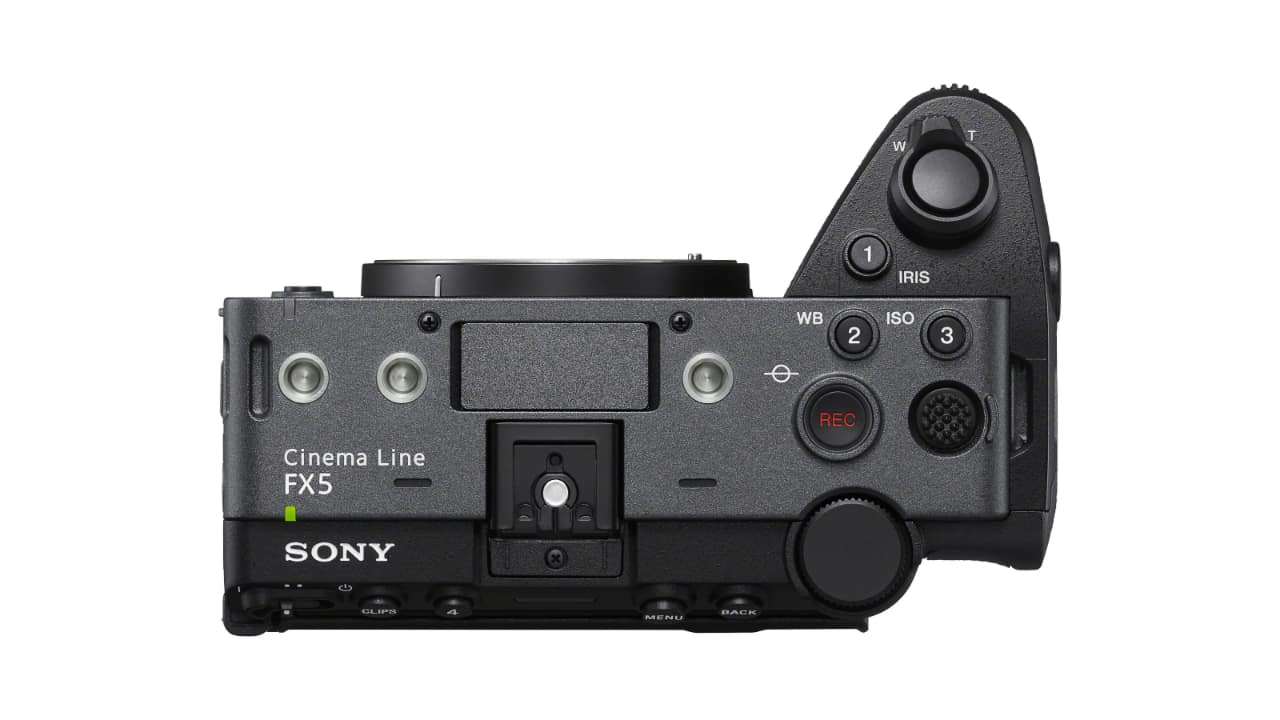 Controls have been reworked to align more closely with VENICE 2 and BURANO: the FX3's rear control wheel is replaced with a new multi-function dial, alongside a front dial, power switch, zoom lever and multi selector laid out in the same style as VENICE 2's operating controls. The mount index, multi-function dial and buttons are also designed with distinct shapes and tactile feel so they can be operated without relying on visual confirmation.
The menu system moves from the FX3's ILC-style interface (shared with Sony's Alpha stills cameras) to a new CineAlta-style system matching VENICE 2, BURANO, and the FX6, with a full menu screen, a home screen, a menu screen and a user functions screen. Sony's stated rationale is that the FX5 should be easy to pick up as a secondary camera on a VENICE 2 set, or alongside the FX6.
This means it uses the BIG6 home screen, which inherits operability cultivated through CineAlta cameras and consolidates key settings, frame rate, exposure, LUTs, and more, into a single display. It's accessible from anywhere in the menu system with a press of the home button, though Sony notes it's the one screen that can't be output over HDMI.
The FX5 also includes a screen reader function that reads menus aloud, and an enlarged menu display option, both aimed at supporting visual accessibility. Supported languages for the screen reader vary by sales region, and not every menu item is covered.
The FX5 carries the same optical 5-axis in-body stabilization hardware as the FX3, but with the latest stabilization unit, Sony says the roll correction range has been expanded to approximately twice that of the previous system, more effectively suppressing rotational blur. Alongside the existing optical stabilization and Active Mode, the FX5 adds Dynamic Active Mode, which narrows the angle of view (and disables Clear Image Zoom) in exchange for steadier handheld footage. Dynamic Active Mode is available up to 60fps, with gain limited to the equivalent of 26dB.
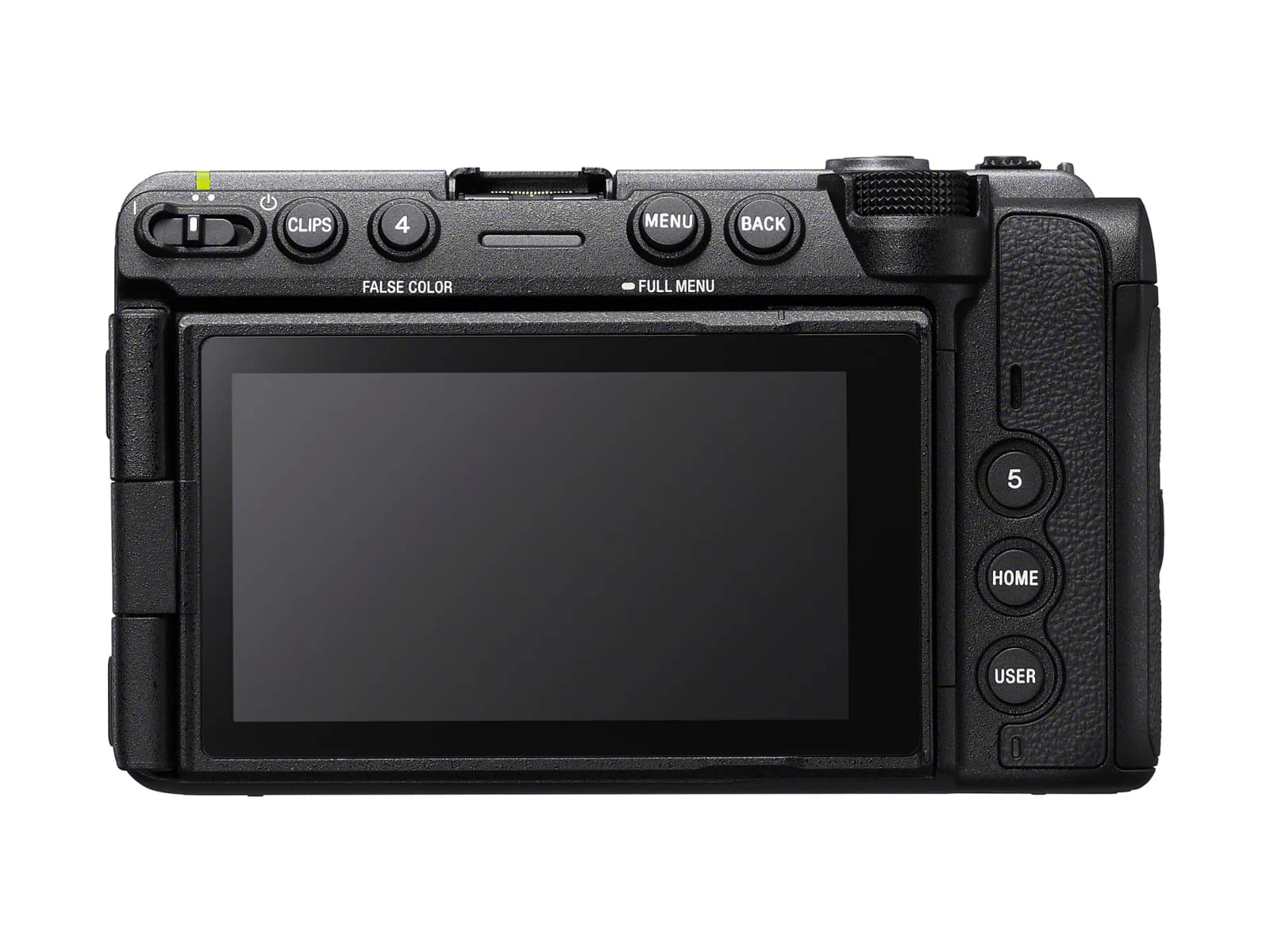 The FX5 has a 3.5-type, approximately 2.76-million-dot, 16:9 touch-panel four-axis multi-angle LCD monitor, larger and brighter than the FX3's. It tilts approximately 98 degrees upward and approximately 40 degrees downward, and opens approximately 180 degrees sideways, with brightness adjustable across 15 steps. Shooting information can be displayed around the top, bottom, left and right edges of the screen so it doesn't overlap the image itself.
Monitoring tools are substantially extended with the addition of false colour, waveform and vector scope displays, joining the existing histogram, zebra and focus peaking options.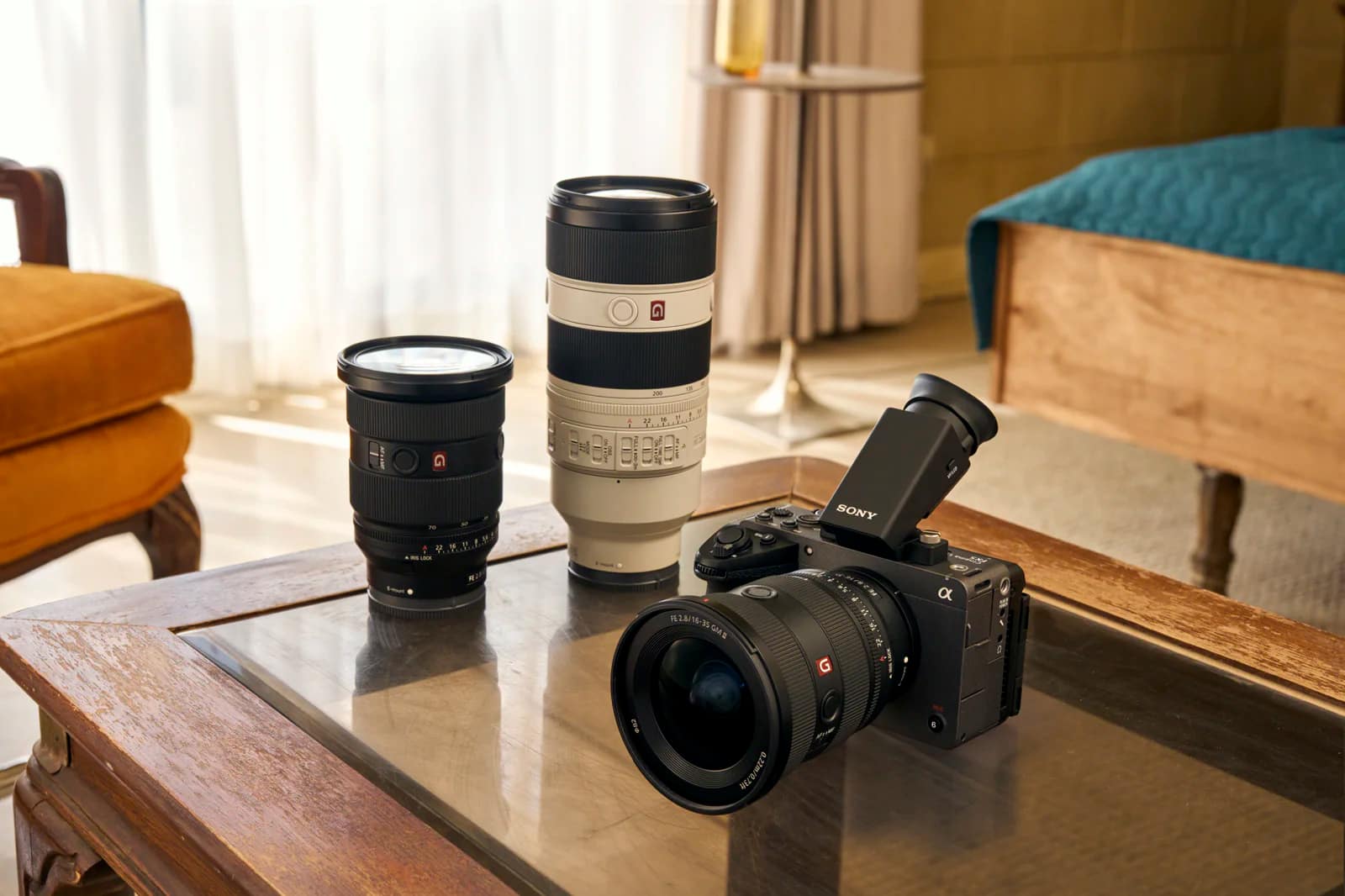 The FX5 also gets an optional detachable OLED electronic viewfinder, the DVF-EL1: a 0.58-type panel with approximately 7.07 million dots, supporting HDR display with a DCI-P3-equivalent colour gamut and 10-bit gradation, and approximately 0.9x magnification. It tilts from 0 to approximately 90 degrees and can switch between resolution-priority and eye-point-priority display modes. It attaches and detaches as needed rather than being a fixed part of the body, and cannot be used together with any accessory mounted via the Multi Interface Shoe, including the new XLR handle unit. The DVF-EL1 will be priced at €750.
Autofocus is powered by AI-based human pose estimation, which detects not just eye position but the position of the body and head, improving AF performance in dark scenes. The FX5 also supports Real-time Tracking, automatically tracking a subject and maintaining stable focus. A new Auto Tracing White Balance (ATW) mode combines visible light and IR sensor data with deep learning-based light source estimation to deliver more stable, natural white balance in shaded areas, indoors, and other tricky lighting situations. Noise Suppression can also be toggled on or off to suit the shooting or post-production workflow.
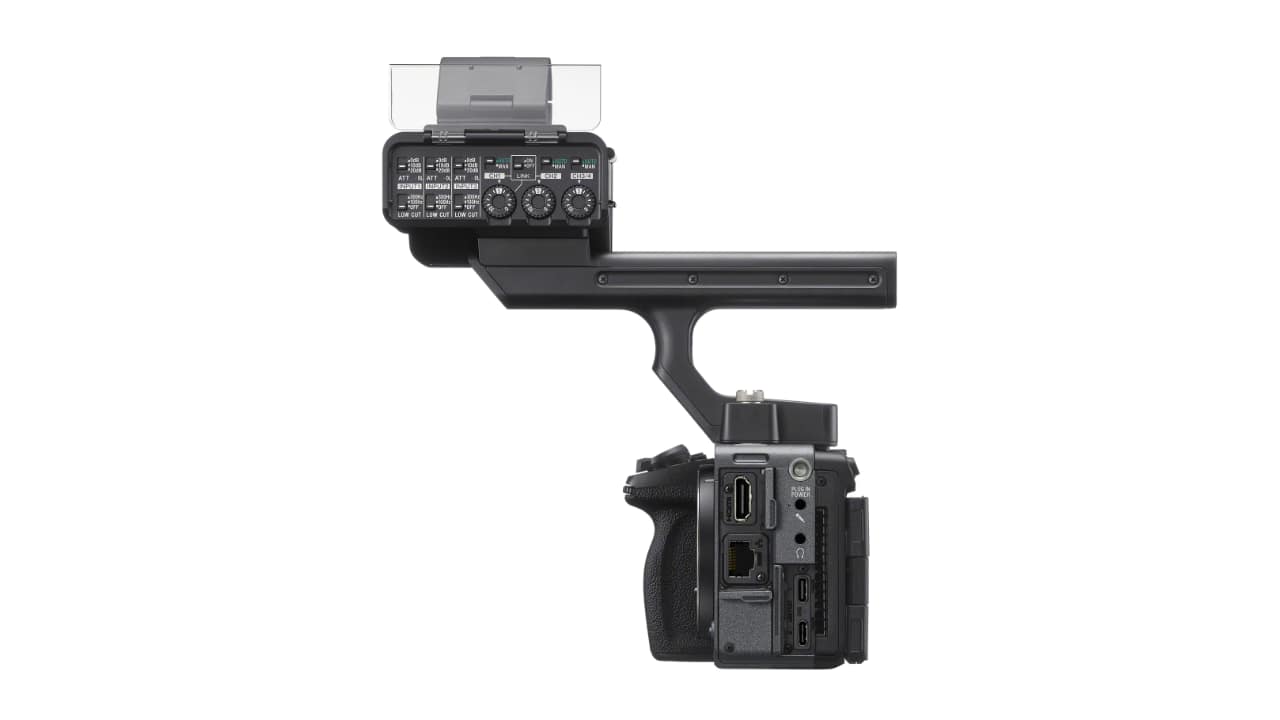 A new XLR Handle Unit, the XLR-H2, adds two XLR/TRS combo terminals supporting up to four channels of audio, with dual AD converters enabling in-camera recording at up to 96kHz, 32-bit float. It connects directly to the camera body via the Multi Interface Shoe. Sony points out that the existing XLR-H1 handle used on other Cinema Line cameras cannot be attached to the FX5 because of different screw positions; the XLR-H2 is a dedicated, separate accessory, priced at €900, and is not bundled with the standard body-only purchase.
The FX5 is compatible with Sony's recently released NP-SA100 battery (2670mAh), which offers approximately 1.3 times the capacity of the standard NP-FZ100 used across much of Sony's range, along with improved power management and battery deterioration status reporting. Sony has not published a specific continuous-recording-time figure for the FX5 at the time of writing.
Storage moves to dual CFexpress Type A slots, which also accept SDXC UHS-II and UHS-I cards.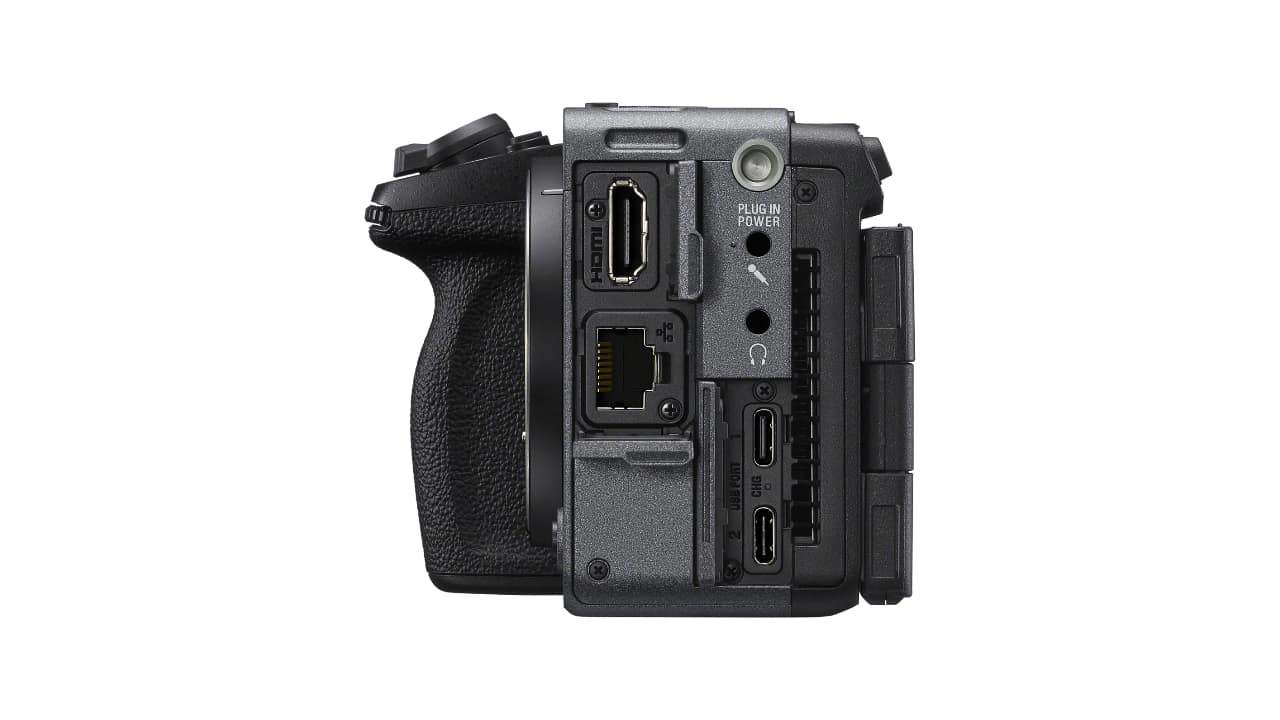 Ports include HDMI Type A, mic and headphone jacks, a wired LAN (Ethernet) terminal, and two USB Type-C ports, one of which supports external power via USB Power Delivery for stable long-duration shooting (a compatible USB PD power supply and cable are sold separately). The body also gains additional 1/4-20 UNC screw holes in various locations, allowing accessories to be attached directly without a cage.
A high-efficiency cooling fan, housed in its own independent air chamber, is paired with an optimised heat dissipation design for stable operation during long recording sessions, alongside a dust- and moisture-resistant build for demanding outdoor environments.
Wireless support includes Wi-Fi 6E with 2.4 GHz, 5 GHz and 6 GHz bands available (subject to regional regulations), up from the FX3's 2.4/5 GHz-only support. The FX5 can act as an access point or as a station connecting to a 6 GHz-enabled access point, and Sony says the faster, more stable 6 GHz connection meaningfully cuts transfer times for large video files. Through the Monitor & Control app, the FX5 supports video monitoring and remote operation from smartphones, tablets and Mac computers.
The last of the three new accessories is a Timecode Adapter Cable, the VMC-BNCU1, terminating in BNC on one end and USB-C on the other, priced at €100. It allows the FX5 to receive timecode directly from external timecode devices, supporting accurate multi-camera and audio sync for broadcast and film production workflows.
Not an accessory as such, but something that will still come at an additional fee, is an optional, paid Image Stabilization Fixation Service aimed at productions rigging the camera to vehicles or drones. High-frequency vibration can be a problem here, causing the in-body stabilization to introduce unnatural shaking rather than remove it. Users will have to send the camera to a service centre to have the stabilization unit mechanically fixed in place. The process is irreversible: once locked, a label reading "IBIS Locked" appears on the base of the camera and the image stabilization menu is disabled entirely. Sony has not yet confirmed a launch date or which regions the service will cover.
The FX5 ships with its full launch feature set already described above. A version 2.0 update, planned for August 2027 or later, will add HFR shooting up to 240fps in X-OCN (bringing the 5x slow motion in 5K and 10x slow motion in 4K modes referenced above), XAVC S-I recording in Open Gate 3:2 (extending Open Gate beyond X-OCN for the first time), a user interface optimised for vertical shooting, and a frame grab function for pulling stills from video clips. Sony notes that features and specifications are subject to change ahead of that release.
Sony's Monitor & Control app moves to version 3.0, expanding multicamera control and monitoring for vertical video shooting and adding EL Zone exposure confirmation; it's scheduled for July 2026. Catalyst Prepare and Catalyst Browse are being merged into Catalyst Prepare 3.0, due from August 2026, adding playback and stabilization support for the FX5's new X-OCN C1 and C2 formats alongside metadata-based clip selection.
The Sony FX5 will be available in August for a body-only price of $4999 or $5499 as a kit bundled with the new XLR handle unit. The three new accessories are also priced separately: the TC-Cable at $98, the optional EVF at $698, and the XLR Handle Unit at $798.
Tags: Featured Cameras Sony FX5 Cinema Line


RedShark 2020 @ All rights reserved.

Comments