6 minute read

Apple Computer was founded on April 1, 1976, and in 50 years has changed the creative community like no other company. These are its hits, its misses, and what comes next.
Everyone remembers the Super Bowl ad that launched the Apple Macintosh in 1984. Ridley Scott's dystopian vision cemented the way we looked at Apple, and largely still do, in 90 rather overwrought seconds. No matter that Apple has since become one of the largest private companies ever and is very much as corporate as they come — the image of Tim Cook presenting a gold bar to Donald Trump in 2025 lingers long in the memory — we still feel that it is 'ours', and that it represents the creative industries in a way no other company does.
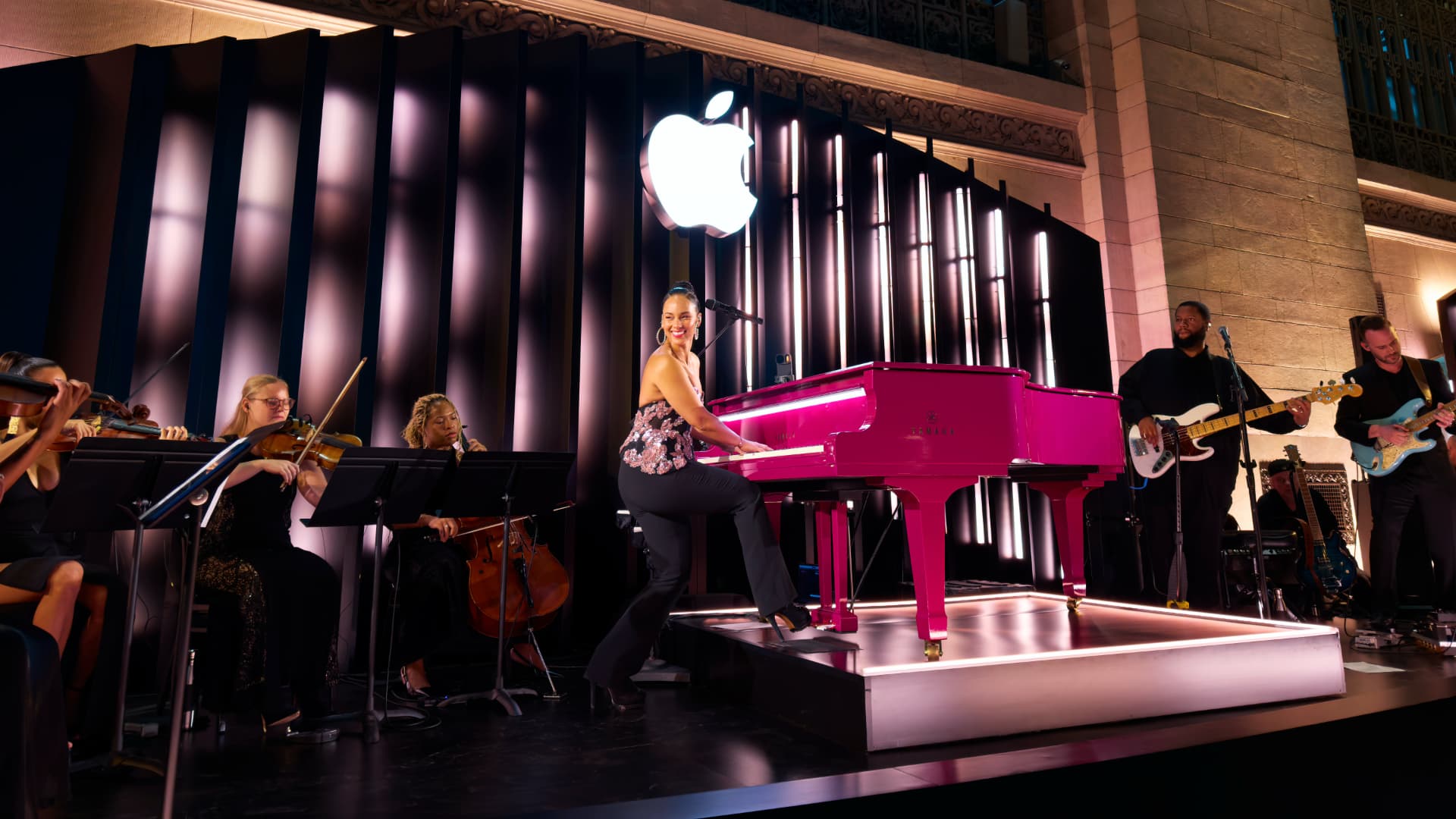 Alicia Keys kicks off Apple’s 50th anniversary celebrations with a live performance atop Apple Grand Central’s iconic steps. Pic: Apple
Apple kicked off its anniversary celebrations on March 13 with a surprise Alicia Keys performance at Apple Grand Central in New York City, with iPhone 17 Pro used to capture the event. Numerous events have taken place worldwide since, and it will reportedly close it with a private Paul McCartney gig at Apple Park. As parties go it will be a long and expensive one, but we thought we'd mark the occasion by looking briefly at the company's legacy when it comes to the creative industries and how, over the course of half a century, it has changed the way we make things.
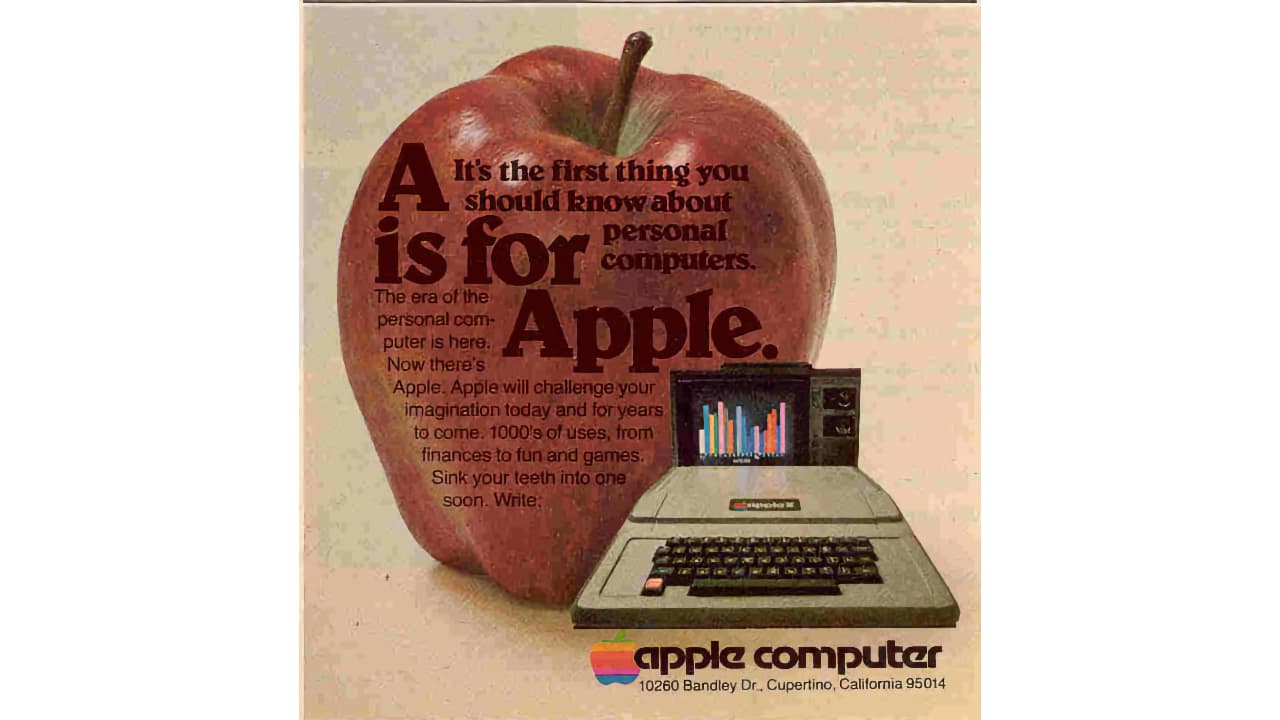 The Apple II plus VisiCalc combination was unbeatable. Pic: macmothership.com
There is nearly eight years between the establishment of the company and the 1984 Superbowl ad. For the creative industries there is not a lot going on here. The Apple II effectively made the company's first fortune by being the only computer that ran the first widely available spreadsheet program, VisiCalc. This is a good early lesson in the fact that software sells hardware.
But while there is no single product that you can really point to in this era that screams 'creative breakthrough', the work the two Steves, Jobs and Wozniak, were putting in to making their machines more user-friendly to a general audience outside of just the computer-obsessed would stand them in good stead when it came to the next phase of the company's history.
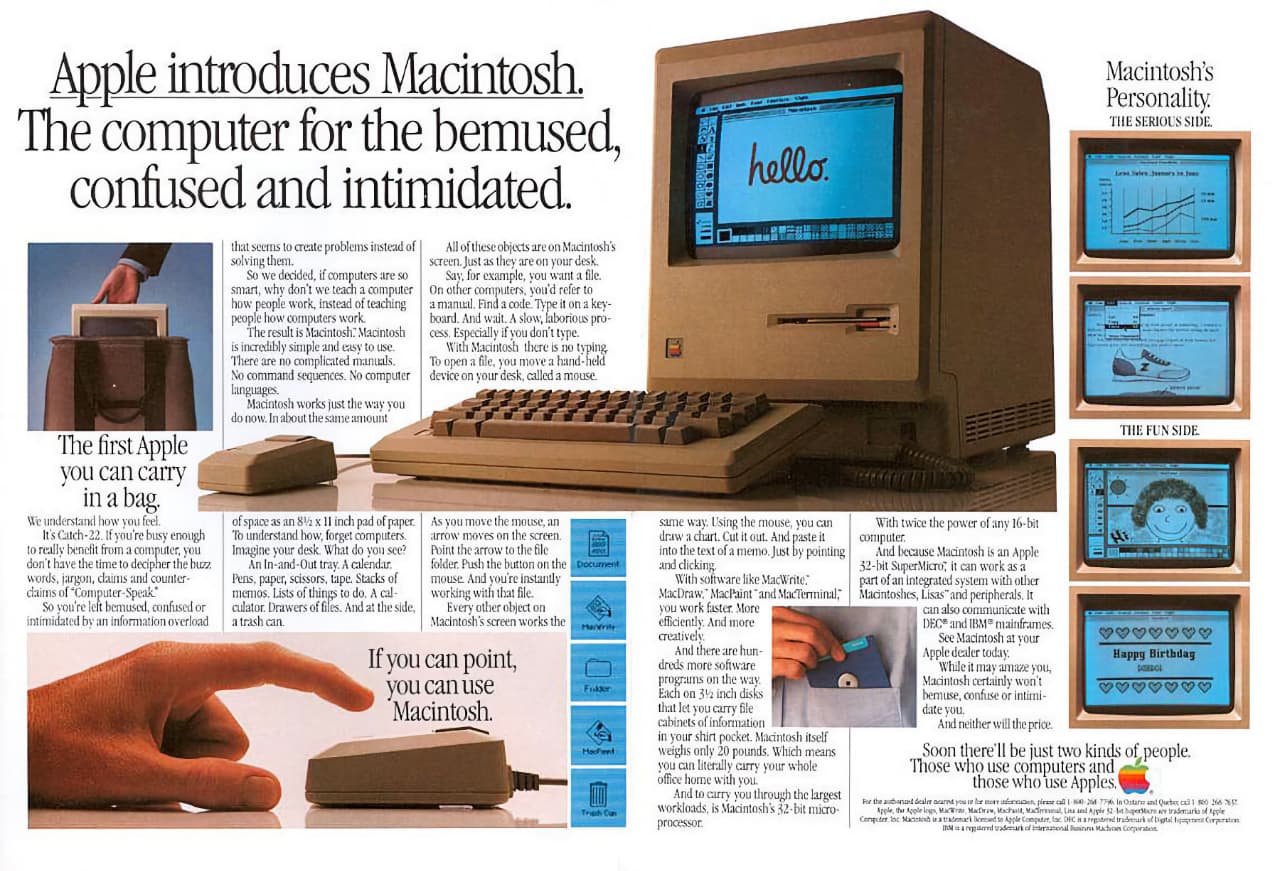 And just like that, everything changed overnight. Pic: macmothership.com
The original 1984 Macintosh gave individuals access to typesetting and layout tools that had previously required specialist equipment and training. The reasons so many journalists still use Macs to this day were set here, as Apple rapidly became the machine of choice for desktop publishing (DTP).
That all sounds relatively benign, but in the first of several uncomfortable parallels with our current unease about AI swooping in for our jobs, it was actually a bloodbath. Pre DTP, professional typesetting could reportedly cost a dollar a word for headlines alone. Designers worked with physical galleys of text cut up on drawing boards and colour separations were made on film, a labour-intensive and expensive process charging hundreds of dollars per page.
That all disappeared in the space of a few years. It is worth remembering that there are always winners and losers and the price of democratizing creative processes can often be measured in jobs and livelihoods.
It's a pattern that Apple would repeat.
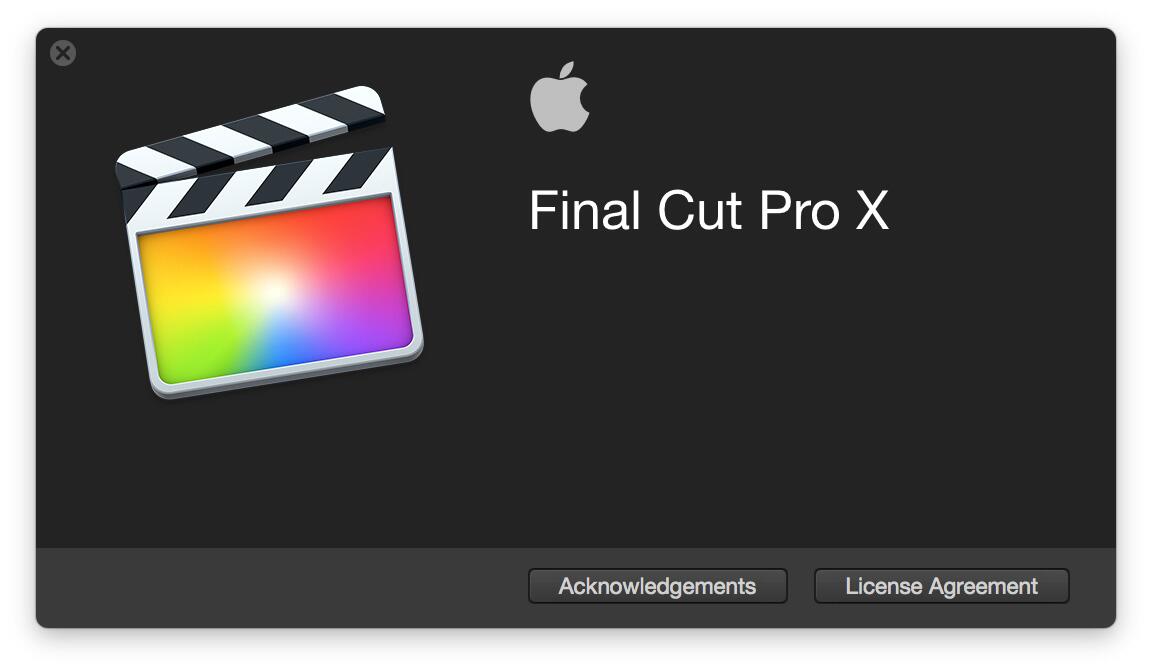 This did not go well...
Adobe's entire creative suite — Illustrator (1987), Photoshop (1990) — was Mac-first and Mac-dependent for years. Apple and the Macintosh didn't just benefit from the creative software ecosystem, it enabled it and incubated it.
Could lightning strike twice? In the end it strikes a good deal more than that, but Final Cut Pro offers a cautionary interlude.
FCP was released in 1999 for $999, which seems an extortionate amount now but at the time was considerably cheaper than the market incumbent, Avid Media Composer. It won a Primetime Emmy Engineering Award in 2002, gained its high-profile users Oscar nominations, was famously used by the Coen brothers to edit No Country for Old Men (2007), and seemed to be unassailable.
The Apple shot itself in the foot with Final Cut Pro X in June 2011. This was a radical rebuild that added many excellent new tools, but also ditched many features mandatory for professional film editors at the same time. Not just film, either. Visit any broadcast facility around that era and you would find editorial teams busy switching away from it, either back to Avid or on to Adobe Premiere Pro
While FCP X has matured considerably, the high-end never really came back. Its market now largely belongs to YouTubers, hobbyists, and advanced content creators rather than professional editors at the highest level. It will be interesting to see how its new home, being rolled into Apple Creator Studio, does for it.
By the time you get to Logic Pro, it's the third time Apple has performed the same manoeuvre: identify a creative domain where the tools are expensive, build (or acquire) something that makes them accessible, bypass the gatekeepers and reshape the industry.
The company acquired Emagic, makers of Logic, for $30 million in 2002, and this time it learns its lessons and doesn’t interfere with the DNA of the product. It’s been estimated that almost 1 in 5 music producers use Logic as their primary production software. And Apple has constructed it its own, dedicated on-ramp, the free GarageBand software allowing anyone interested in making music to dabble before graduating to Logic Pro.
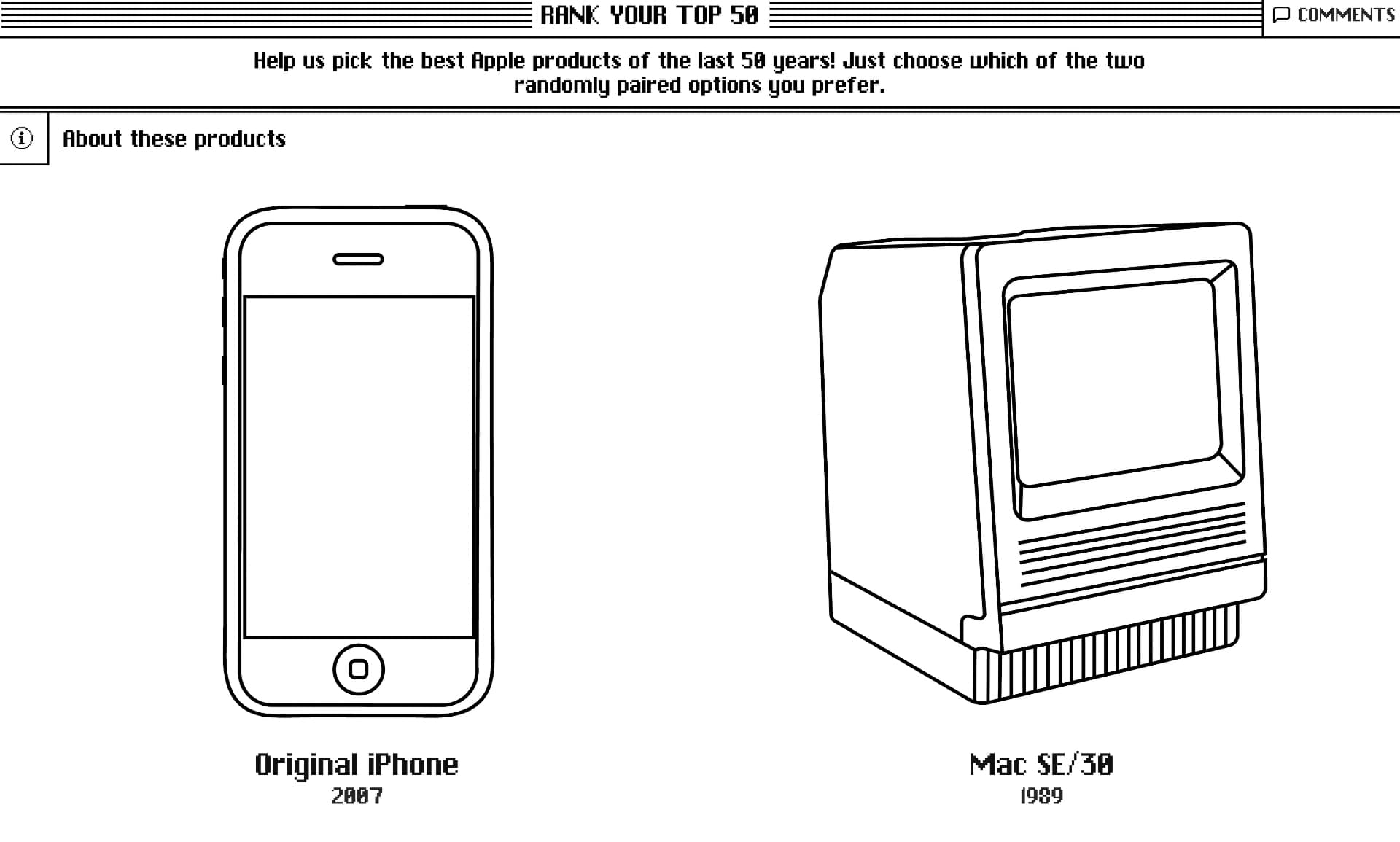 The Verge's Top 50 Apple products vote is done via a series of random matchups
The Verge has been running a live vote for the Top 50 Apple Products from the last 50 years. It’s an entertaining exercise, and while the wisdom of crowds doesn’t always work out (it has the Bondi Blue iMac at Number 5 for some reason), one thing it does get right is that the iPhone is consistently at the top.
Arguably this has been the greatest tool for content creators of them all in the nearly 20 years since it was introduced, and Apple seems set to try and replicate its previous successes in disrupting DTP, NLE, music production with filmmaking.
To date, this has been less successful than previous market land grabs, mainly because it has been so hardware led. There have been successes, sure. Sean Baker shot Tangerine (2015) entirely on three iPhone 5s handsets, winning awards at Sundance, before going on to win four Oscars for Anora in 2024. And Danny Boyle very famously filmed 28 Years Later on iPhone 15 Pro Max.
But to point to the lack of feature films shot on it would be rather to miss the point. In the creator economy the iPhone reigns supreme. There are over 1.5 billion active iPhone units worldwide, and most of them can shoot and edit HD at a minimum. Meanwhile, the company sold 247 million iPhones in 2025, and all of them can shoot, edit, and stream in 4K.
And it’s not shy of continued ambitions in the area, either. Part of the whole furore involving its name being mentioned in the current lawsuit between former colleagues at Lux is down to the fact that its trying to incubate a pro-level upgrade for its Camera app to coincide with the forthcoming iPhone 18 Pro.
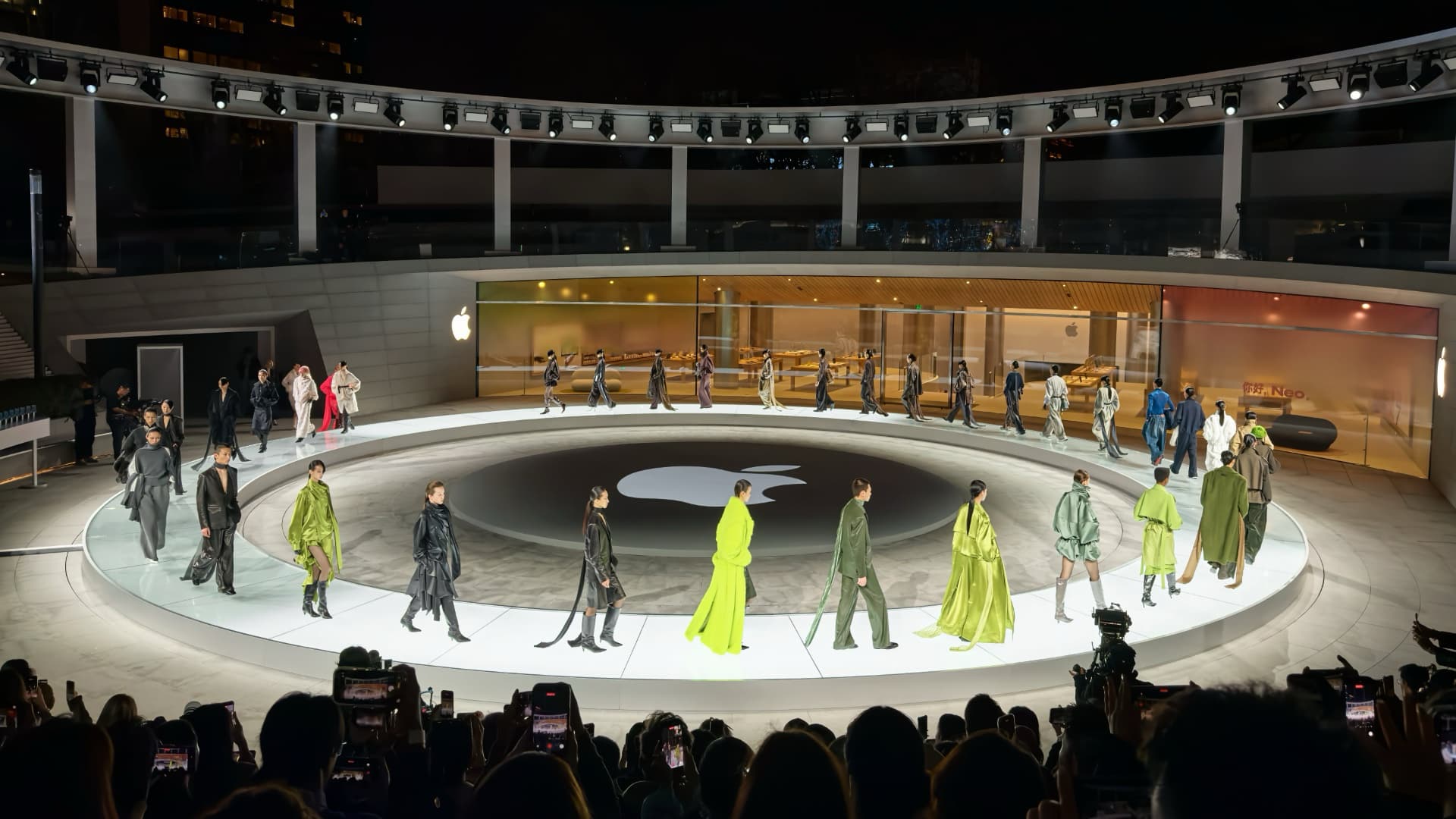 As part of Shanghai Fashion Week, designer Feng Chen Wang presented a special show at Apple Jing’an themed “Life and Love,” celebrating Apple’s 50th anniversary and the company’s spirit of thinking different. Pic: Apple
One area where Apple has resolutely failed to deliver so far is the current new frontier of AI-assisted creative software. All the running here is being made by established companies such as Adobe and any number of start-ups, especially in the video space, all of whom are using third party LLM providers such as OpenAI, Anthropic, Gemini (Google), and others.
Apple’s lack of impact here has been touted as an extreme failure ever since it rush-announced its Apple Intelligence tools at WWDC 2024. Many of them have yet to appear in any way shape or form either, so this is a definite point of view.
But, and it’s a big but, Apple’s modus operandi for close to fifty years has been to hang back, watch the market, and then launch something that is substantially better than the competition either in terms of hardware or in terms of software.
(Apple’s relationship with creative professionals is a bit like a landlord who charges over the odds but actually maintains the building. You resent the premium, you occasionally wish you could leave, but the workflow remains solid and moving is a pain.)
Out of all the Big Tech companies, arguably it is Apple that is spending the least on AI infrastructure. Instead it is licensing the technology on a yearly basis. Currently it is paying Google $1bn a year for Gemini, but if Gemini falls behind it will be able to switch horses and plug in something else. All in all Apple reported about $12.7 billion in total capital expenditure for 2025. Google spent $90 billion, and Microsoft plans $100+ billion for 2026.
In the meantime it has developed increasingly powerful M-series chips with onboard neural processors which are increasingly capable of running LLMs on-device. Rather than centralising AI, it is distributing it and giving it into the hands of its customers. These devices will be able to run dedicated AI models for specific tasks without ever having to connect to the internet.
The creative potential here is huge, and what could emerge is a scenario where Apple users have AI tools at their disposal that are genuinely theirs, trained on their data, and running sustainably on their own devices rather than connecting to data centers and being served x number of ads for every y number of tokens spent.
It would be extremely disruptive to the emerging creative AI industry as a result. And, as we have seen, would not be the first time that Apple has run a similar playbook.
Tags: Post & VFX Apple iPhone Apple Creator Studio


RedShark 2020 @ All rights reserved.

Comments