
3 minute read
Advertisement
Anthropic has released a wave of new connectors for Claude, linking the AI assistant directly into creative tools including Adobe Creative Cloud, Blender, Autodesk Fusion, and Ableton.
As a measure of the speed with which things move in the AI field, we were only talking about Adobe's integration with Claude being in a vaguely sketched future prospect a few days ago. That future is now here, as Anthropic has released a wave of new connectors for its Claude AI model, linking the AI assistant directly into a host of creative tools. The new integrations cover an impressive number of creative workflows and include links to Ableton, Adobe, Affinity by Canva, Autodesk, Blender, SketchUp, Splice, and Resolume.
This is probably the biggest leap into agentic workflows in the creative space we've seen to date. The new connectors allow Claude to act on other software directly: querying documentation, running scripts, modifying 3D scenes, or orchestrating multi-step asset workflows, depending on the platform.
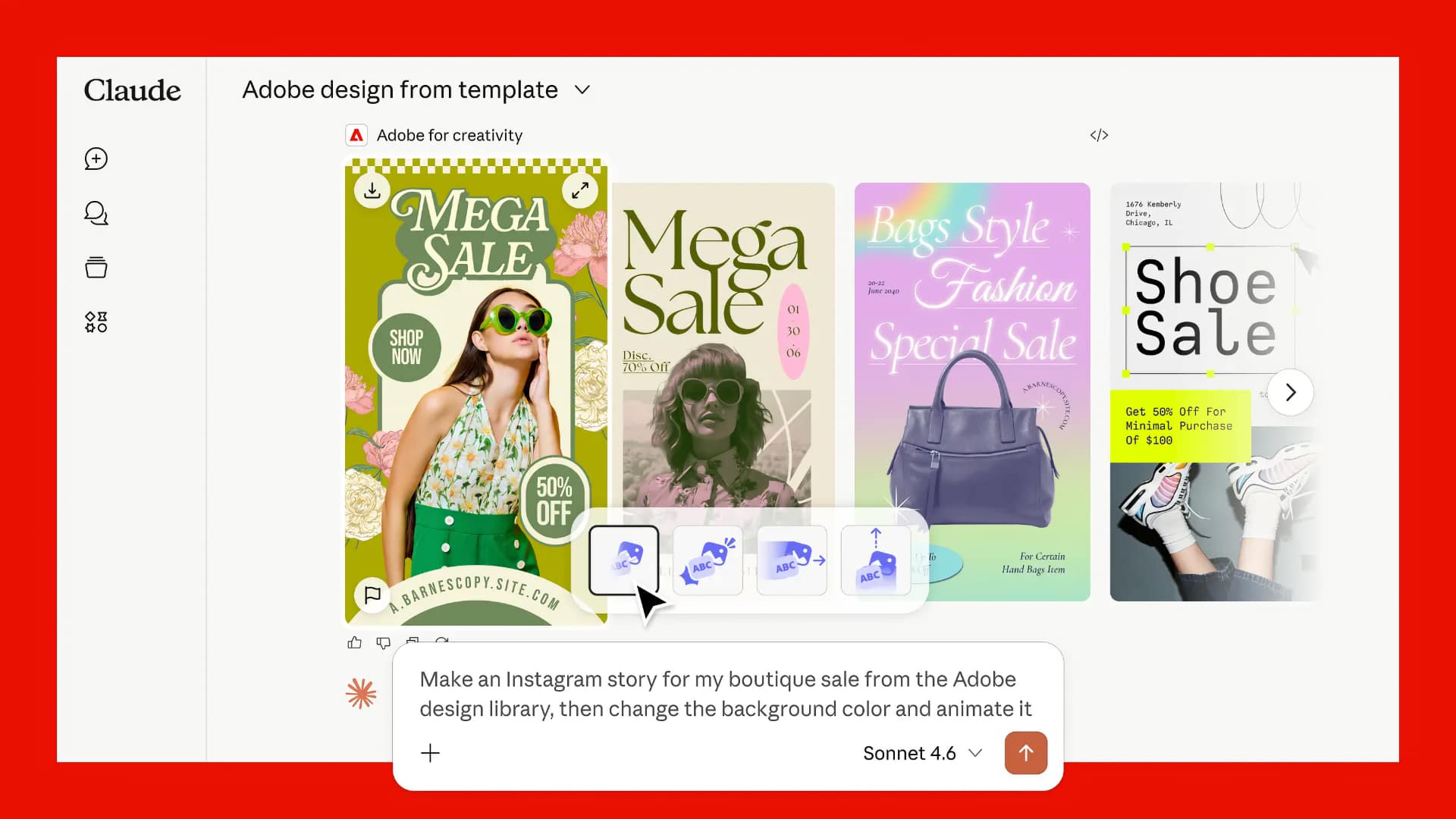
The most comprehensive of the new connectors is Adobe's. The Adobe for creativity connector gives Claude access to more than 50 tools drawn from across Creative Cloud — Photoshop, Illustrator, Firefly, Express, Premiere Pro, Lightroom, InDesign, and Adobe Stock — and can orchestrate them in sequence based on a plain-language description of what the user wants to achieve.
In practice, this means a user can describe a desired outcome such as retouching a set of headshots, reformatting a video clip for Instagram Reels, or designing a social post from a campaign brief. The connector then selects and chains the appropriate tools without the user having to specify a workflow. Assets produced inside Claude can then be sent to Adobe's apps directly for further refinement, or downloaded for use elsewhere.
The connector is available globally from today. A Claude account is required, but an Adobe account isn't. Adobe simply says that "If you have an Adobe account, make sure to sign in to unlock higher usage limits, more tools, and work that saves across sessions." It also points to the fact that it is its Firefly AI Assistant that "provides the full experience of our creative agent."
What this means in terms of exactly what you can do with the Claude/Adobe integration with different levels of access and different usage limits in play is going to require a bit of real world experimentation.
It is, however, not the only newly integrated tool that Claude offers. The Blender connector, built by the Blender developers and officially available for Claude from today, exposes the software's Python API through a natural-language interface. Users can analyze scenes, debug setups, batch-apply changes to objects, or add tools directly to Blender's interface through conversation. Anthropic has joined the Blender Development Fund as a patron, and notes the connector is built on MCP, making it accessible to other LLMs as well as Claude.
The Autodesk Fusion connector allows Fusion subscribers to create and modify 3D models through conversation. SketchUp lets users describe a room, piece of furniture, or site concept in Claude, then open the result in SketchUp for further work. Resolume Arena and Wire connectors let VJs and live visual artists control both applications in real time through natural language.
Ableton's connector grounds Claude's answers in official documentation for Live and Push. Splice's connector lets music producers search its royalty-free sample catalog from within Claude. Affinity by Canva automates production tasks such as batch image adjustments, layer renaming, and file export across Affinity workflows.
Anthropic is also working with art and design programs at RISD, Ringling College of Art and Design, and Goldsmiths, University of London to develop curricula around the new tools, with students and faculty getting early access.
Attitudes to AI announcements like this tend to fall into two categories: that it's apocalyptic for the creative industries, or that we are entering a new golden age. On the whole we are seeing an enthusiastic response from tech generalists and anxiety among creative professionals, with the "agentic AI doing actual things to your files" aspect of the whole evolving process giving people understandable pause.
We don't know exactly how it will shape out either, but this will all probably land somewhere in the middle of the two opposing camps. And it is only fair to point out that the money will run out and the bubble will burst way before AI gets round to building Skynet. Then we will hopefully be able to have a more sensible, nuanced conversation about AI's evolution, impact, and the next steps for our industry and others.
For this part of the bubble cycle though, this is all part of a big push by Anthropic into the creative industries and certainly the visual space. OpenAI's ChatGPT has led it in image generation for a while now, but these integrations and the announcement of Claude Design in mid-April, show that Anthropic has every intention of going toe-to-toe with its rival here too.

Written by Andy Stout
Advertisement
Advertisement
Advertisement
Advertisement
Advertisement
RedShark is a multiplatform online publication for anyone with an interest in moving image technology and craft. With over 50 contributors worldwide, full-time developers, editorial, sales and marketing staff, it is the go-to site for informed opinion and know-how for the quickly changing video, film and content creation industries.

RedShark 2020 @ All rights reserved.

Comments