4 minute read

Cinewhoop FPV drones are reshaping Winter Olympics coverage, delivering immersive, high-speed perspectives that bring viewers closer to athletes than ever before.
There’s been no shortage of drama at the 2026 Winter Olympics so far, but Australian teenager and Women’s Big Air qualifier Ally Hickman almost added to the unwanted stories when she nearly got hit by one of the 15 FPV drones in use by Olympic Broadcast Services at the 2026 Winter Olympics.
Various rights issues prevent us from finding any footage of the incident, but anyone watching the live pictures being transmitted from the drone as Hickman came off the ramp had an alarmingly close view of her helmet as she launched into her trick. The replay shows the drone flying lower and closer than its usual course when tracking the athletes before suddenly pulling up sharply.
“I saw on the replay that I nearly got hit by it but I wasn’t aware of it while I was doing it,” Hickman said in the Australian press.
Which shows just how in the zone she was, as the high-pitched whine of FPV drone motors is rapidly becoming a signature soundtrack of the Games. And, near misses aside (and this is the only one we know about to date), the footage they are broadcasting is taking the coverage of the Games to a new level of thrill.
Drones have been part of Olympic broadcasting since their debut a dozen years ago at the Olympic Winter Games Sochi 2014. Their use and capabilities have expanded at every subsequent edition as drone technology has dramatically improved. At Paris 2024, FPV drones were introduced for the first time into live mountain bike coverage, delivering an unprecedented, immersive vantage point for fans worldwide.
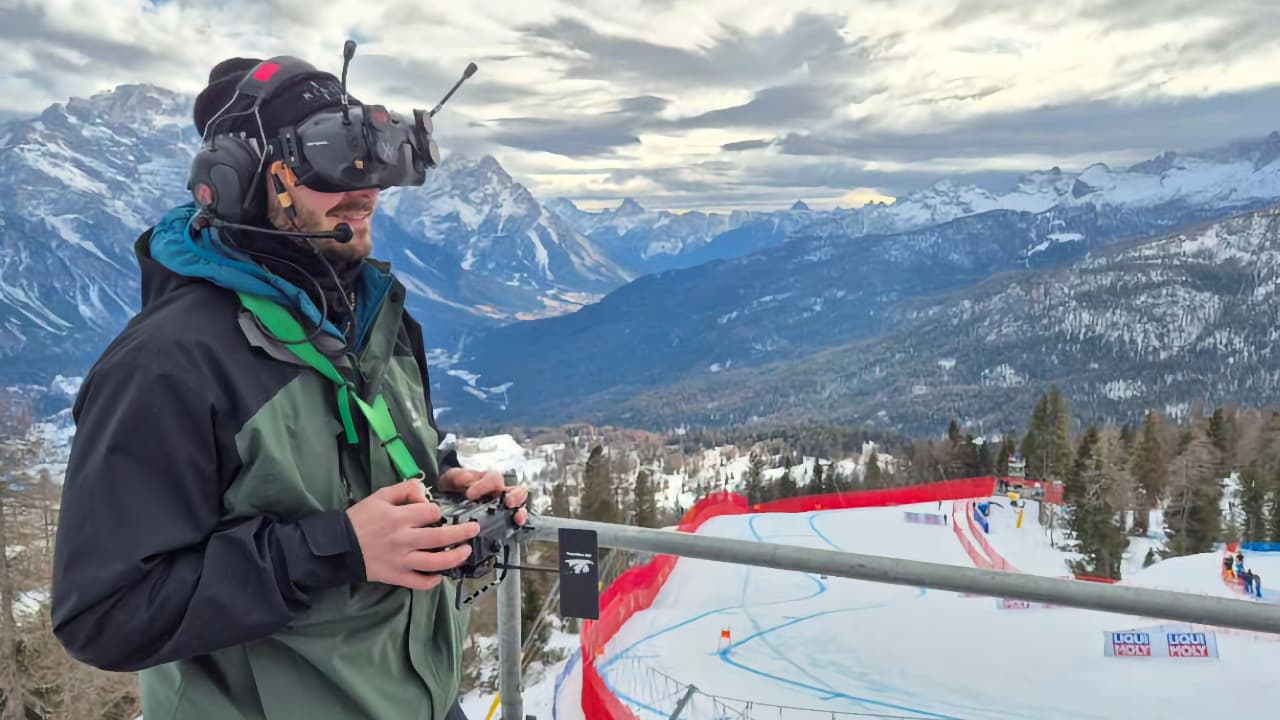
Milano Cortina 2026 marks the Winter Games debut of FPV drones as part of a load out of over 800 cameras. They are being used both outdoors and indoors, with up to 15 FPV drones deployed across venues. Thanks to advances in design, transmission, and the development of sub-100 ms low-latency systems, drones now deliver broadcast-quality footage in real-time, making what OBS says is now “one of the most powerful storytelling tools in live sport.”
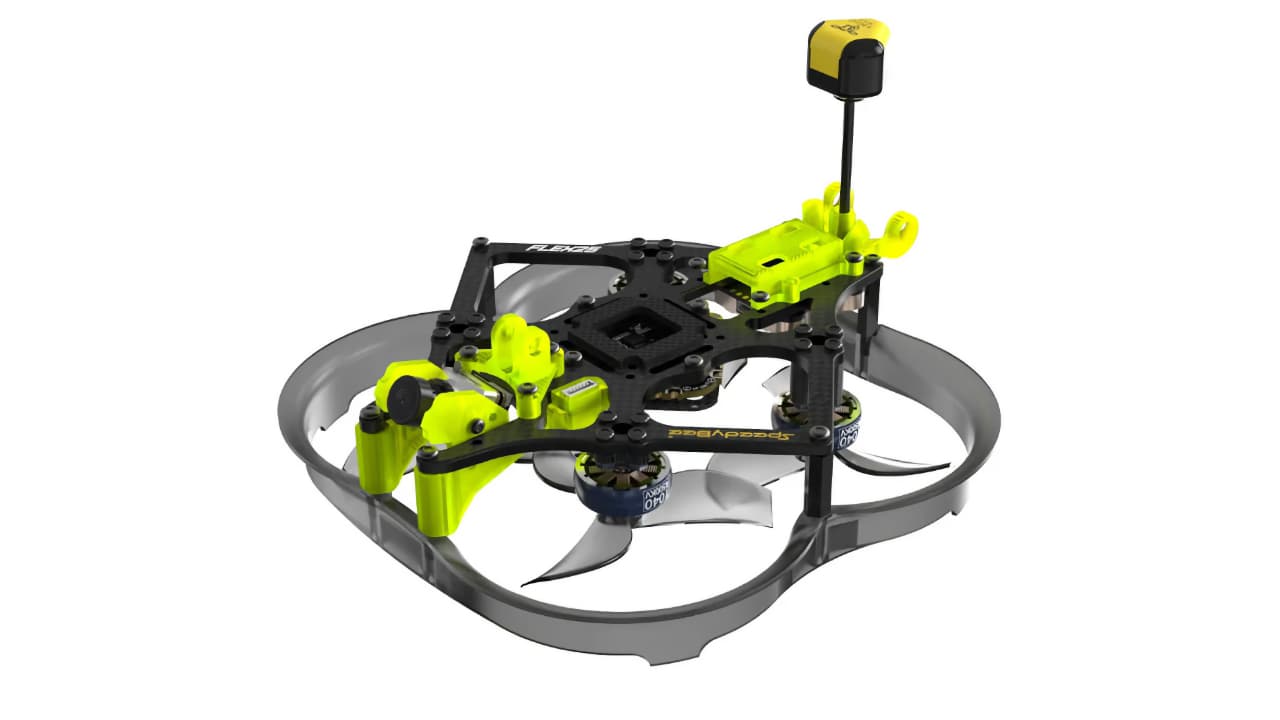 The units in question are called cinewhoops. And while you can buy models such as the $200 SpeedyBee Flex25 Analog above online (DJI makes one too in the shape of the $999 Avata 2, with an Avata 3 rumored to be imminent), the ones used in sports broadcasting are usually custom-built rigs.
They feature a ducted and inverted blade design, with propellers mounted beneath the frame. This improves aerodynamic efficiency and allows for smoother flight curves, which is crucial when following athletes through steep descents and tight turns. The batteries are designed for rapid replacement, with special consideration given to the cold for the Winter Olympics. These usually last for two athlete runs before needing to be swapped, giving them a total flight time of around 3-6 minutes.
According to OBS, understandably delivering these dynamic shots requires a carefully designed setup. Outdoors, drone pilots operate from elevated positions to maintain line-of-sight with athletes on approach and departure, ensuring precise tracking at high speeds. Nearby, a heated support cabin serves as the operational base, equipped with battery charging stations, spare drones, receivers, and dual monitors. This setup allows teams to monitor both signal integrity and race developments in real-time.
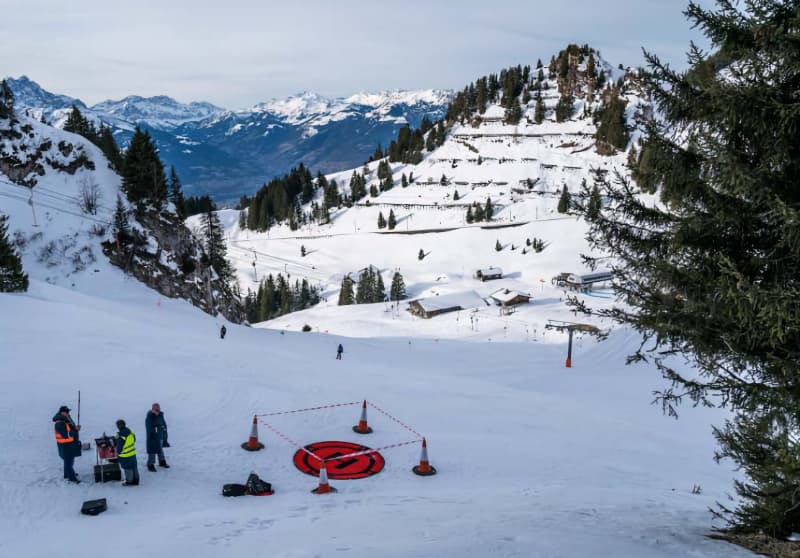
Each drone team consists of three specialists: a pilot, a director, and a technician. They work in sync via a dedicated communication channel to manage flight paths, timing, and technical adjustments. Continuous coordination with the OB van and technical crews enables real-time video filter adjustments to adapt to weather and light conditions, ensuring consistent image quality across venues.
10 more standard drones are also being used by OBS for more conventional aerial and beauty shots.
Coordination is key to all this and safety paramount, as the near-miss of the Ally Hickman incident proves.
All drone flights are conducted in close cooperation with the Italian Civil Aviation Authorities, Prefectures, and Police, and in coordination with International Federations, venue management, and production teams. OBS says flights are meticulously planned and carried out exclusively in controlled areas. Drones maintain safe distances from athletes, spectators, and restricted zones. All operations are pre-approved by relevant authorities and flown by certified professionals, in strict accordance with aviation regulations and safety protocols at each venue.
Still, some of the flying undertaken, such as drones following luge riders down the Milan-Cortina bobsled track, is taking place at high speed in confined surroundings. OBS says these will be flying at anything up to 140 kph (87 mph) as they dive in and out of the curves following the athletes down the track.
This shows just how different the coverage using FPV drones can be. Previously, any coverage of sliding sports has had to be a succession of fast cuts from fixed position cameras, with maybe a jib holding a slider in the centre of the frame as they rocket round a 180-degree curve. The following drone shot lets the director follow the athlete round multiple curves, building a more comprehensive picture than ever of the sheer speed and skill of the sliders as they hurtle down the course. Same with the downhill skiing.
“Free from cables or ground constraints, these drones can track athletes at near-competitive speeds, delivering dynamic coverage that replicates the athlete’s own perspective,” writes OBS. “This immersive angle conveys speed, terrain changes, and technical skill in ways no other system can.”
It’s been a couple of years now since the Dutch Drone Gods raced Max Verstappen with their custom 350 kph drone. Watching the thrilling Olympics drone coverage make you wonder just how exciting F1 coverage would get with a drone tracking cars as they negotiate some of the more interesting curve complexes that grace the world’s race tracks. Maggots into Becketts and onto the Chapel Straight at Silverstone comes to mind...
You’d imagine that there needs to be a bit more safety work done first, though, as well as trying to get broadcast-spec low latency drones literally up to speed. But at least the F1 engine noise would mask the whine of the drone motors…
Tags: Production Drones Sports Broadcasting Winter Olympics 2026


RedShark 2020 @ All rights reserved.

Comments