3 minute read

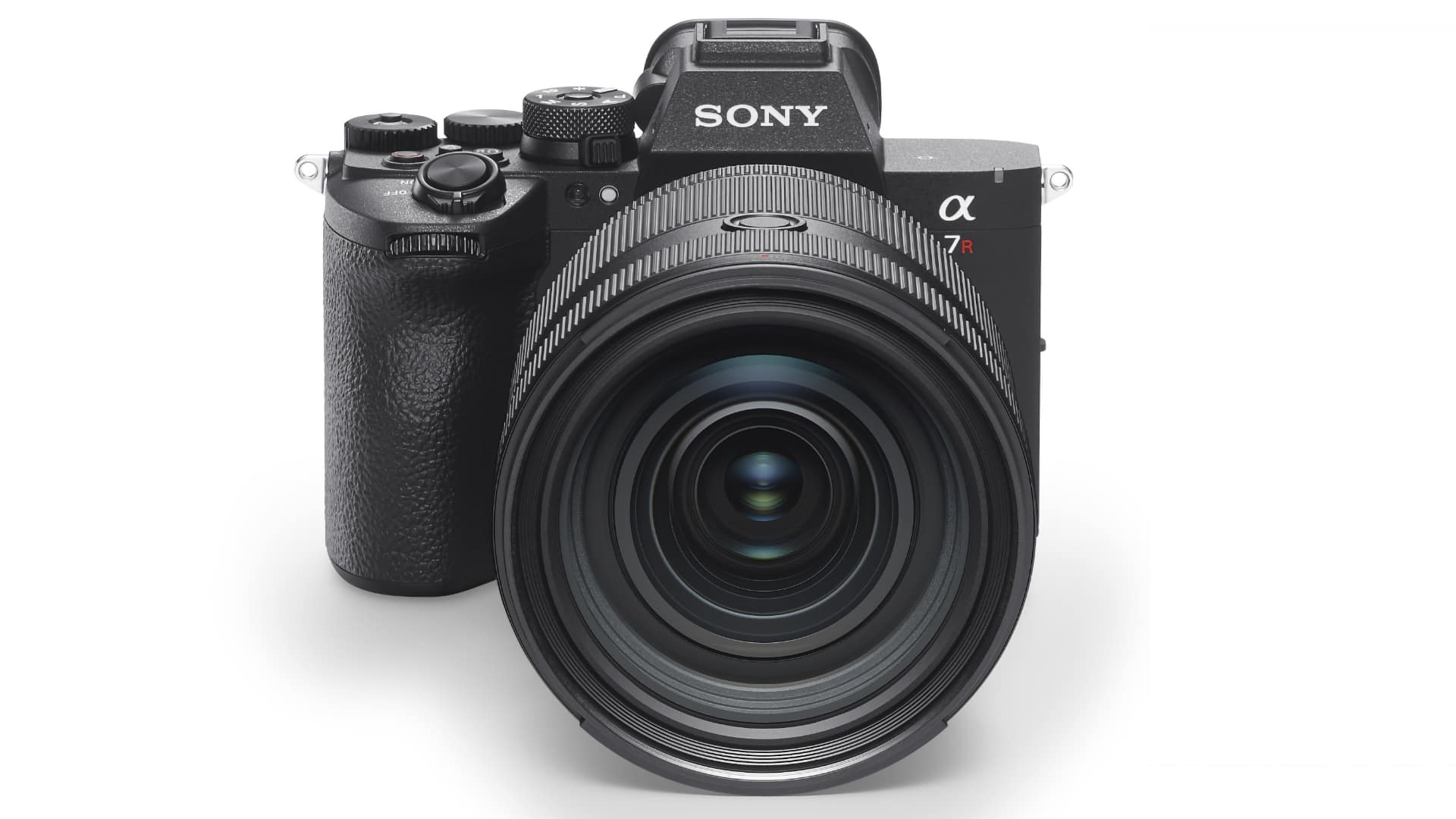
Sony's Alpha 7R VI pairs a new 66.8 MP fully-stacked Exmor RS sensor with the BIONZ XR2 engine, 8K video, and 30 fps continuous shooting. Priced at $4499, it arrives in June 2026.
Sony has announced the Alpha 7R VI, the sixth generation of its high-resolution full-frame mirrorless series. The camera pairs a 66.8 MP back-illuminated, fully-stacked Exmor RS CMOS sensor with the new BIONZ XR2 processing engine, and is positioned as the highest-resolution body in the Alpha lineup with the fastest continuous shooting performance in the series to date.
What's more, the camera has come in at $500 under the lowest price that the rumor mill suggested it would be, a competitive body-only $4499. Given everything else going on with electronics pricing at the moment, this is welcome news.
The fully-stacked sensor design enables approximately 5.6x faster readout than the a7R V, blackout-free continuous shooting at up to 30 fps, and up to 60 AF/AE calculations per second. Dynamic range is rated at up to 16 stops, with native sensitivity from ISO 100–32000, expandable to ISO 50–102400. Sony also adds two action-oriented modes new to the R series: Pre-Capture, which begins buffering at 30 fps on a half-press of the shutter (configurable from 0.03 to 1.0 second), and Speed Boost, which lets users instantly jump to a faster frame rate via a custom button.
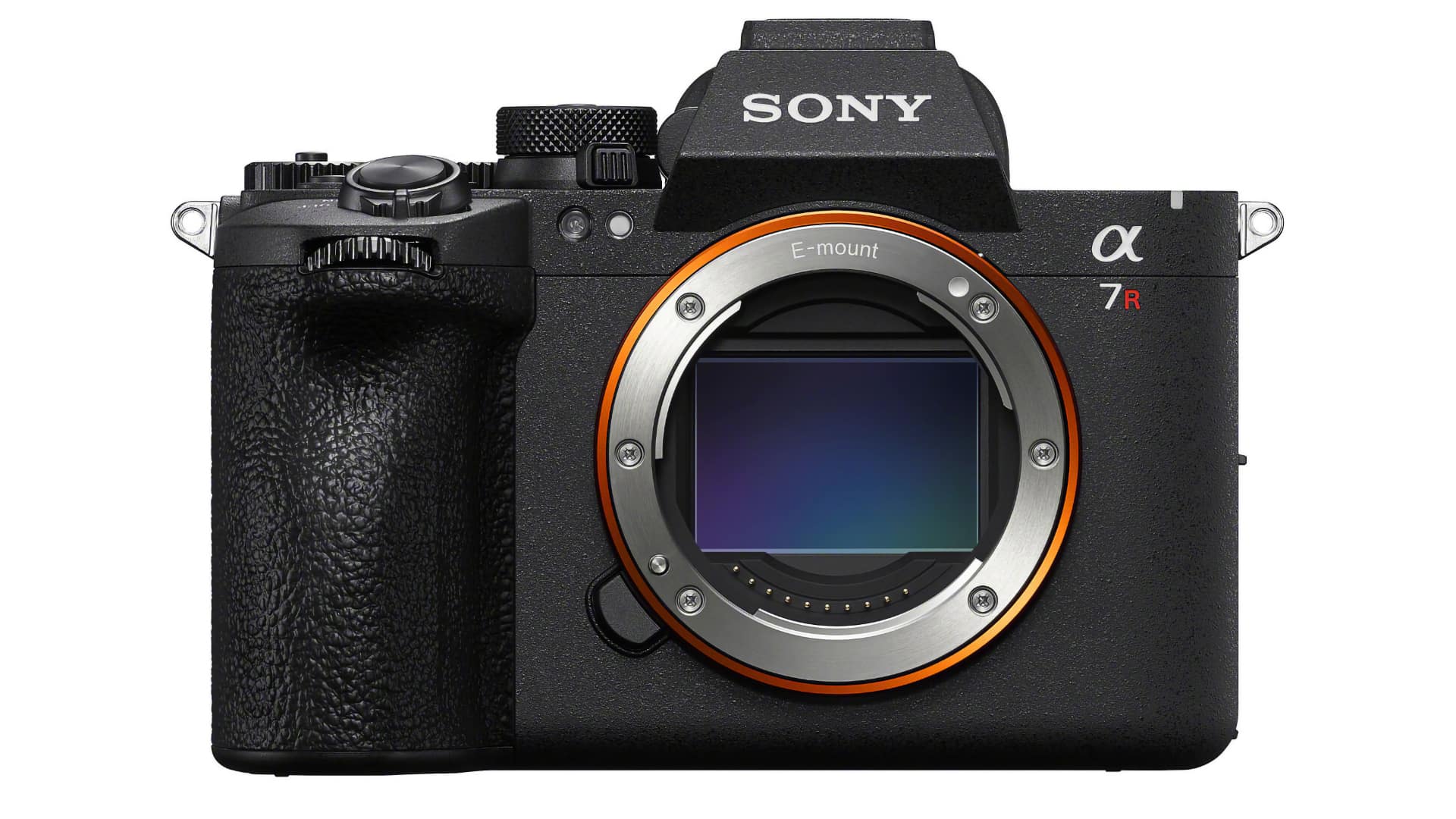 The Alpha 7R VI body-only front view, with Sony's E-mount and the new 66.8 MP fully-stacked Exmor RS sensor visible
Autofocus uses Sony's Real-time Recognition AF+ system with a dedicated AI processing unit, covering 759 phase-detection points across 94% of the full-frame area (100% in APS-C crop) with sensitivity down to -6 EV. Subject recognition covers seven selectable types: human, animal, bird, animal/bird combined, insect, car/train, and airplane. Human tracking uses skeletal-based pose estimation to maintain focus on a targeted subject even in crowded scenes or when partially obscured. AF is sustained across all 30 fps frames and includes Focus Breathing compensation for compatible E-mount lenses.
Five-axis IBIS is rated at 8.5 stops at the frame center and 7.0 stops at the periphery, with an Active IS video mode and updated digital stabilization for OSS-enabled lenses. Pixel Shift Multi Shooting composites 4 or 16 exposures for approximately 265.8 MP of output, while multi-image HDR and noise reduction modes can composite between 4 and 32 raw frames.
Video capabilities have been improved over the previous generation and include 10-bit full-frame 8K at 30/24p via 8.2K oversampling, 4K at 120p via 5K oversampling, and Super 35 4K at 60p via 6.3K oversampling. ProRes RAW output is supported over HDMI. Color tools include S-Cinetone, S-Log2/3, and LUT import.
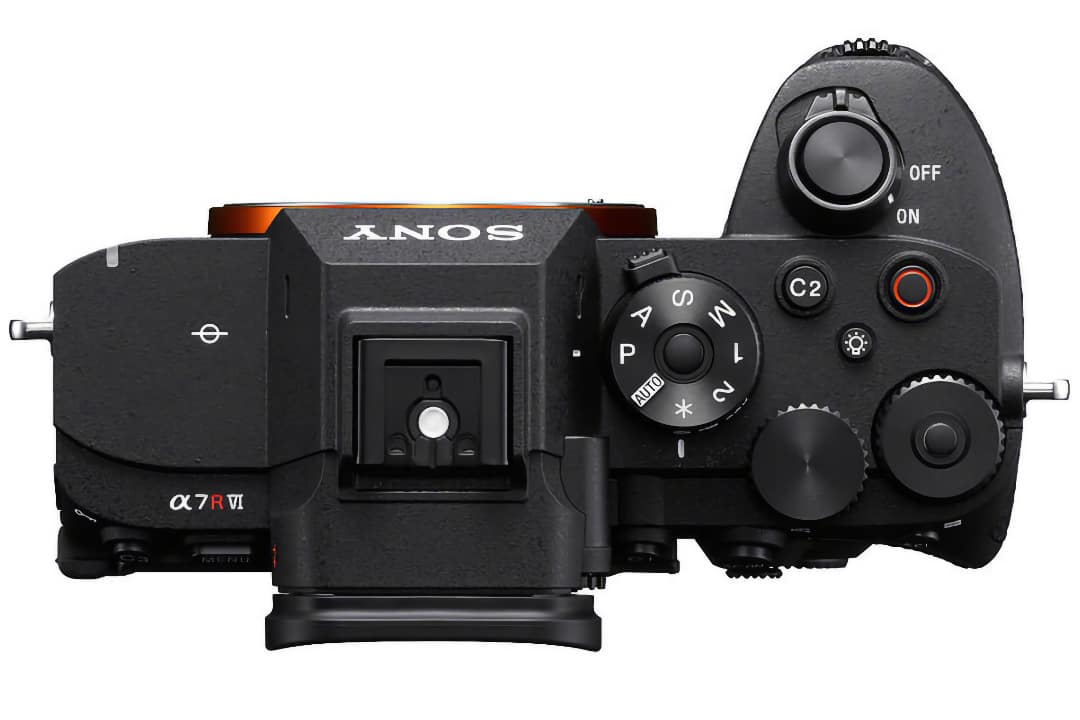 The top plate of the Alpha 7R VI, showing the revised mode dial and control layout
A new Dual Gain function reduces noise without affecting shadow detail, though it limits output to 4K/30p at ISO 400 (or ISO 200–3200 with S-Log3). Improved heat dissipation thanks to a sigma-shaped graphite heatsink built into the stabilization unit allows up to 120 minutes of 8K or 4K/120p recording at 25°C (77°F), dropping to 60 minutes for 4K and 30 minutes for 8K at 40°C (105°F).
The EVF is a 9.44 million-dot QXGA OLED panel with 0.9x magnification, 10-bit HDR, DCI-P3 equivalent coverage, 120 fps playback, a 25 mm eye point, and rated at approximately three times the brightness of the A7R V. The 3.2-inch 2.1 million-dot touchscreen LCD uses a 4-axis multi-angle design that combines tilt and vari-angle functionality, also with DCI-P3 coverage.
Connectivity includes a full-size HDMI A port, dual USB-C ports (USB-C 3.2 Gen2 at 10 Gbps for data; USB-C 2.0 for power), Wi-Fi 6 (5 GHz and 6 GHz with 2x2 MIMO), Bluetooth, a PC sync terminal, and 3.5 mm headphone and microphone ports. The camera supports 4K livestreaming and is UVC/UAC compliant. A USB-Ethernet adapter enables wired LAN at up to 1000BASE-T.
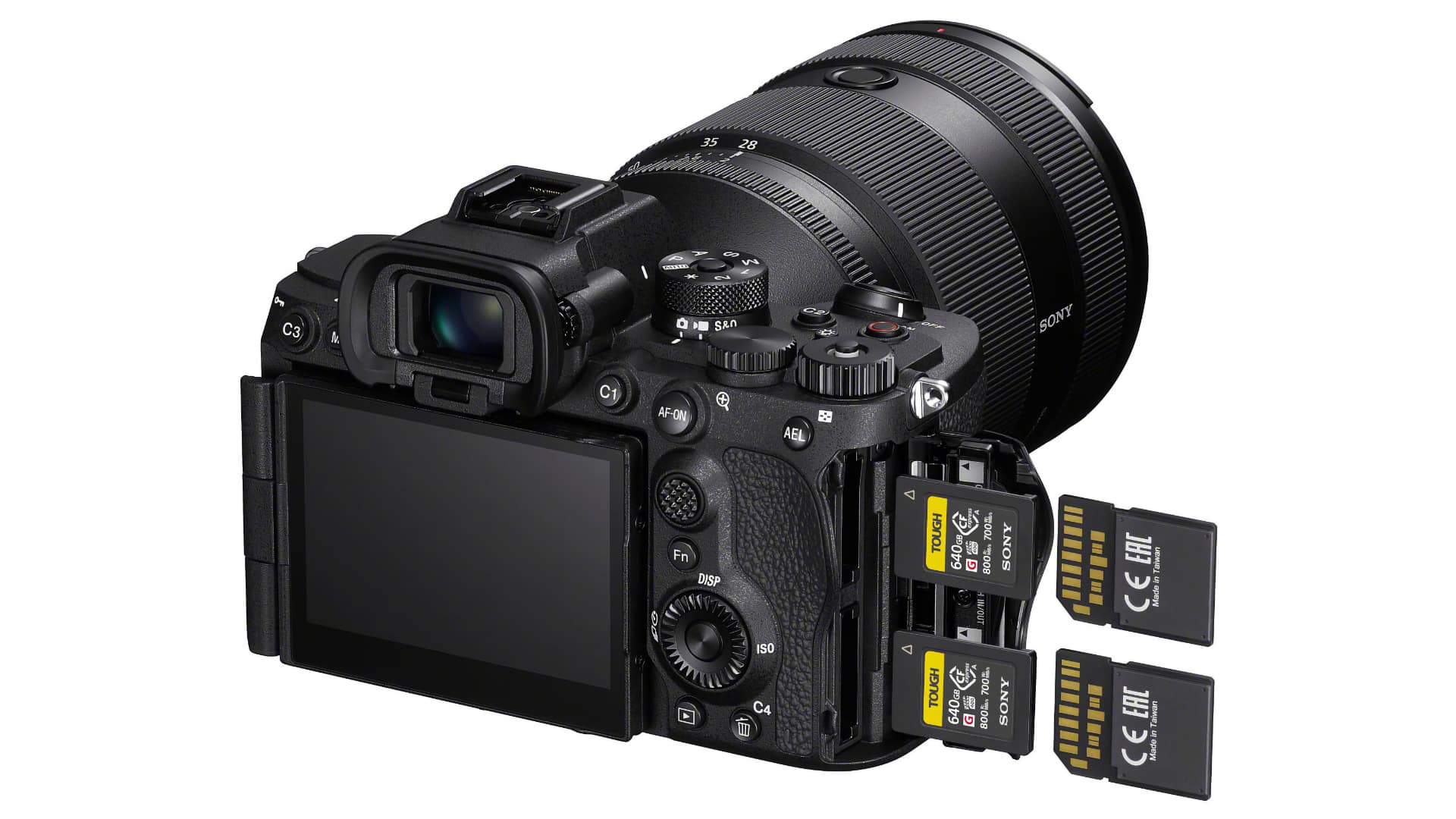 The Alpha 7R VI features dual card slots accepting CFexpress Type A and SD media
The new NP-SA100 battery (2670 mAh) supports up to 710 stills via LCD or 600 via EVF (CIPA). Associated accessories include the BC-SAD1 dual charger, VG-C6 vertical grip (dual NP-SA100), and DC-C2 DC coupler.
The optional XLR-A4 adapter mounts via the Multi Interface Shoe and provides 4-channel audio with 32-bit float recording at 96 kHz, with a separate WAV file save option. An integrated noise reference microphone aids background noise reduction.
The Alpha 7R VI (ILCE-7RM6) is priced at $4499, with the XLR-A4 adapter at $779. Both are due in June 2026.
Tags: Cameras Sony Sony Alpha Sony a7R VI


RedShark 2020 @ All rights reserved.

Comments