4 minute read

NVIDIA unveiled DLSS 5 at its GTC conference this week, billing it as the biggest leap in computer graphics since real-time ray tracing arrived in 2018. Safe to say, it did not go down as well as it hoped.
DLSS 5 was announced by NVIDIA this week, the company promising a real-time neural rendering model that infuses pixels with photoreal lighting and material when it ships in the fall, and the "most significant breakthrough in computer graphics since the debut of real-time ray tracing in 2018.
CEO Jensen Huang was his usual understated self, calling it "the GPT moment for graphics — blending handcrafted rendering with generative AI to deliver a dramatic leap in visual realism."
The reaction from gamers and developers was rather less enthusiastic.
Previous DLSS versions were, at heart, performance tools that amped up the graphics they were fed. They worked by upscaling lower-resolution frames, generating additional frames to boost perceived frame rates. DLSS 5 marks a fundamental shift, targeting visual fidelity rather than raw performance, and leaning heavily into NVIDIA's ubiquitous work on AI to deliver the goods.
Basically, it applies what NVIDIA calls 3D-Guided Neural Rendering to inject photorealistic lighting, subsurface scattering on skin, and material effects on fabric and hair into game scenes.
This is not a post-process filter layered on top of an image. The model effectively participates in the formation of the final frame, filling in detail in ways that align with learned and generalized representations of how light and materials behave.
That means it fundamentally changes the image from what a games developer signed off on, and this has gone down about as well with the development community as motion smoothing on televisions has with your average Hollywood director.
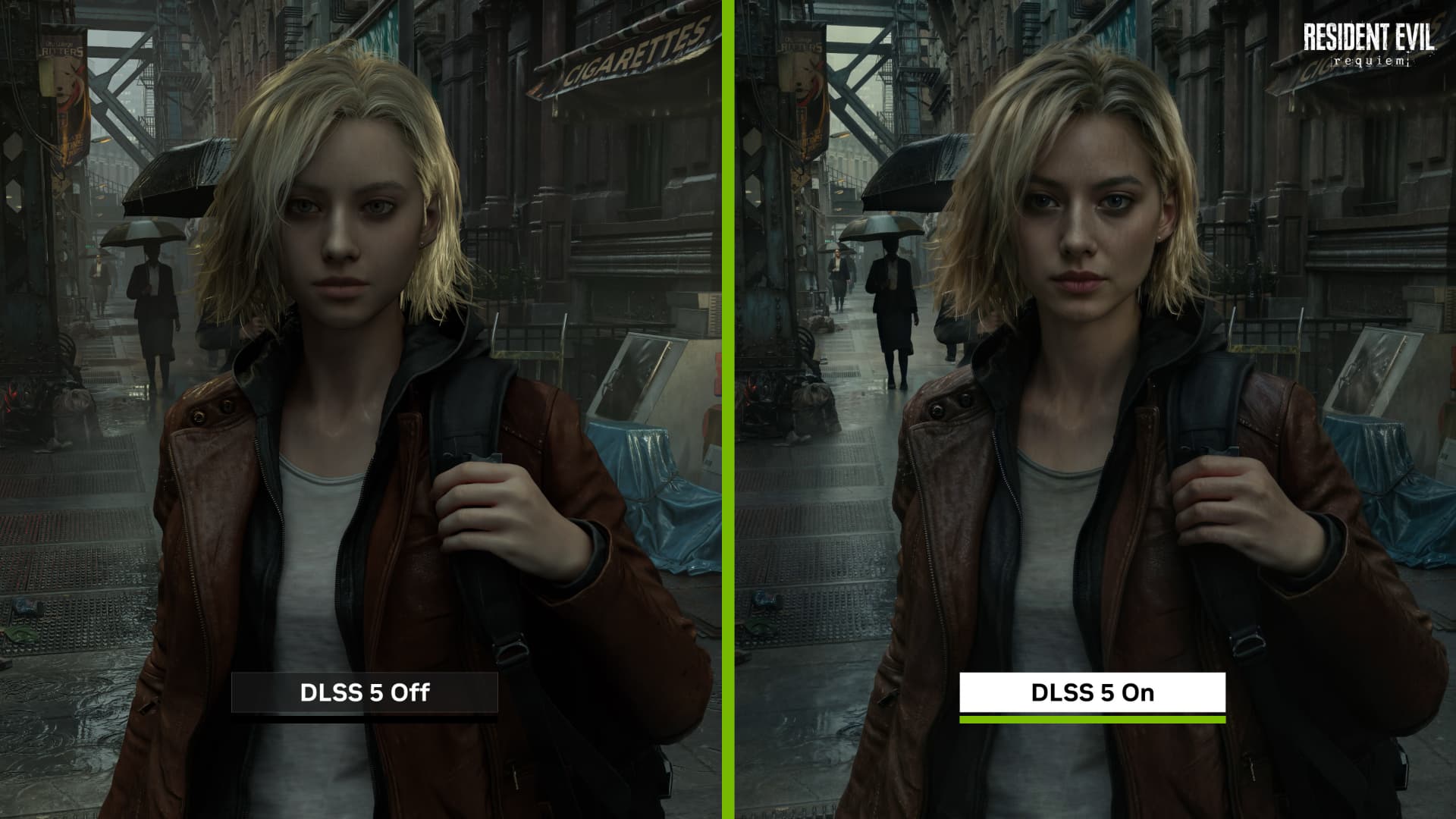
The demos at GTC ran on a PC featuring dual RTX 5090s, which as some have waspishly pointed out is around $8000 worth of GPU just to watch Grace Ashcroft from Resident Evil Requiem get an unsolicited AI makeover.
And it was the treatment of her, and others, that ignited the initial criticism. Critics argued DLSS 5 was effectively applying AI beauty filters to game characters, overwriting the deliberate artistic choices of the development teams.
The main reveal trailer has passed 1.7 million views. It has 16k likes on YouTube, whereas one comment ("Now your game can look like an ai generated image wow") has 23k.
Game developers were vocal. Artist Karla Ortiz argued the technology was "disrespectful to the intentional art direction of devs," on Bluesky, suggesting that if developers wanted to lean into hyper-realism, they would have done so themselves.
Developer SolidPlasma called it a "misguided attempt at realism... in attempting to make characters appear more human, it removes everything original about their designs." The word "slop" appeared in reactions across social media with impressive regularity.
There was also a more pointed allegation that Capcom hadn't even signed off on showing their game. While Bethesda stressed its artists would remain in control, Capcom apparently knew nothing about the demo.
Nvidia CEO Jensen Huang, asked at a press Q&A about criticism that the technology makes games look homogenous or represents only Nvidia's aesthetic vision, was unequivocal. "Well, first of all, they're completely wrong," he said, in response to a question from Tom's Hardware editor-in-chief Paul Alcorn. He argues that DLSS 5 provides developers with direct control over geometry, textures, and generative elements, and describes it as "content-control generative AI" rather than conventional generative AI.
Interestingly, there is now a lengthy pinned comment under the YouTube video that says "Important to note with this technology advance - game developers have full, detailed artistic control over DLSS 5's effects to ensure they maintain their game's unique aesthetic. The SDK includes things like intensity, color grading and masking off places where the effect shouldn't be applied. It's not a filter - DLSS 5 inputs the game’s color and motion vectors for each frame into the model, anchoring the output in the source 3D content."
Away from gaming, FXGuide has noted that in virtual production, the possibility of achieving more final-pixel quality lighting in real time could reduce the reliance on heavier offline re-rendering. "For interactive digital humans or installations, training environments, or live performances, – the ability to deliver more convincing material and lighting response at interactive frame rates is significant."
You are never far away from controversy, though. Digital Foundry, which had exclusive hands-on access to DLSS 5 demos at GTC, published an enthusiastic initial assessment before finding itself engulfed in the same firestorm.
Founder Richard Leadbetter later acknowledged the coverage had been rushed, saying the team had "gone straight from seeing the demos into making the video."
Both Leadbetter and colleague Oliver Mackenzie received death threats over their coverage, with Leadbetter calling the reaction "completely unacceptable." DF team member Alexander Battaglia voiced his own reservations in the follow-up video, expressing concern that DLSS 5's AI model was "over-averaging and over-perfecting things based upon presumably the training data" in ways he found "ethically very problematic."
DLSS 5 is designed for use on a single GPU and will ship this fall, though which RTX architectures will support it has yet to be confirmed. Neither AMD nor Intel has anything comparable in the pipeline as FSR and XeSS remain performance tools rather than neural renderers, which means NVIDIA has an open goal ahead of it if it can turn around public sentiment
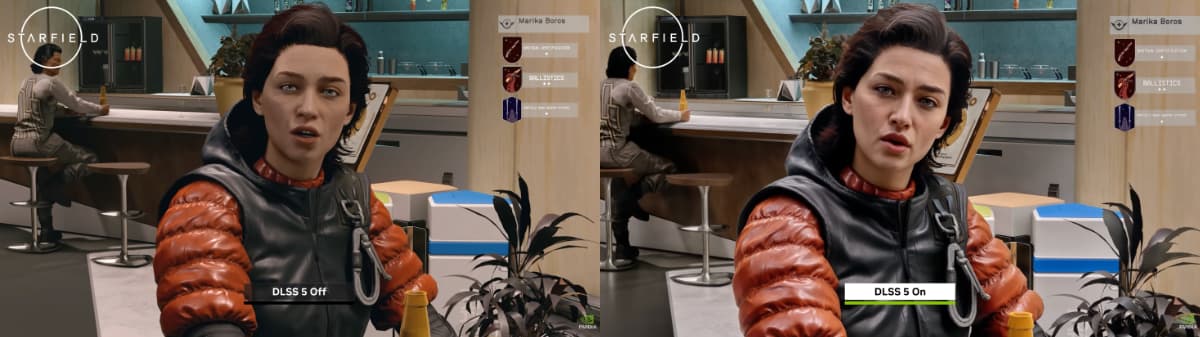
The technology has backing from major publishers including Bethesda, Capcom, Ubisoft, and Warner Bros. Games, with titles including Starfield, Hogwarts Legacy, Assassin's Creed Shadows, and Resident Evil Requiem among the first wave of titles.
Whether the backlash will matter in the long run is genuinely hard to call. The gaming community has historically bridled at new NVIDIA technologies. DLSS upscaling itself was initially treated with suspicion before eventually reaching acceptance.
But there is a pronounced anti-AI sentiment running through this particular reaction that feels different in character, and more trenchant opposition to generative AI being used to alter the nature of creative work after the artists have signed off on it.
The demos probably didn't help. While NVIDIA understandably wanted to highlight the power of DLSS 5 to the max, using it on games that weren't built with the technology in mind — without even alerting the developers ferchrissakes — was always going to produce exactly the kind of uncanny valley results that the gaming community despises.
When it actually ships, on tuned implementations with proper developer oversight, the picture may look quite different. And for VFX work it could produce some absolutely stunning results.
Tags: Technology GPUs Nvidia DLSS 5


RedShark 2020 @ All rights reserved.

Comments