4 minute read

With one major manufacturer saying all its NAND flash production for 2026 is already sold out, how the AI build-out is pushing up electronics prices for the creative industries.
It has been a bad week for anyone that was hoping that the pressure on memory, specifically DRAM and NAND flash, for mainstream devices was going to ease at any time soon. The problem is that production capacity is being diverted to the high-bandwidth memory (HBM) required for the incessant building of data centres as Big Tech sinks trillions of dollars into the AI gold rush. Given the long lead times in the industry and the limited speed at which new fabs can be brought online, that means a classic supply shortage is well underway.
The world's top three memory chip producers - Samsung Electronics, SK Hynix, and Micron - have all said in recent months that they are struggling to keep up with demand. The problem is that Nvidia’s latest systems support up to 288 gigabytes of HBM for every logic chip, compared with the typical 8GB for smartphones and 16GB for laptops. And multiple data points so far this year show that the supply crunch is not slowing down either. Indeed, it’s likely to get worse before it gets better.
The lead times point is illustrated by the fact that Kioxia, one of the leading companies working in the field, says that its entire NAND flash production for 2026 is already sold out.
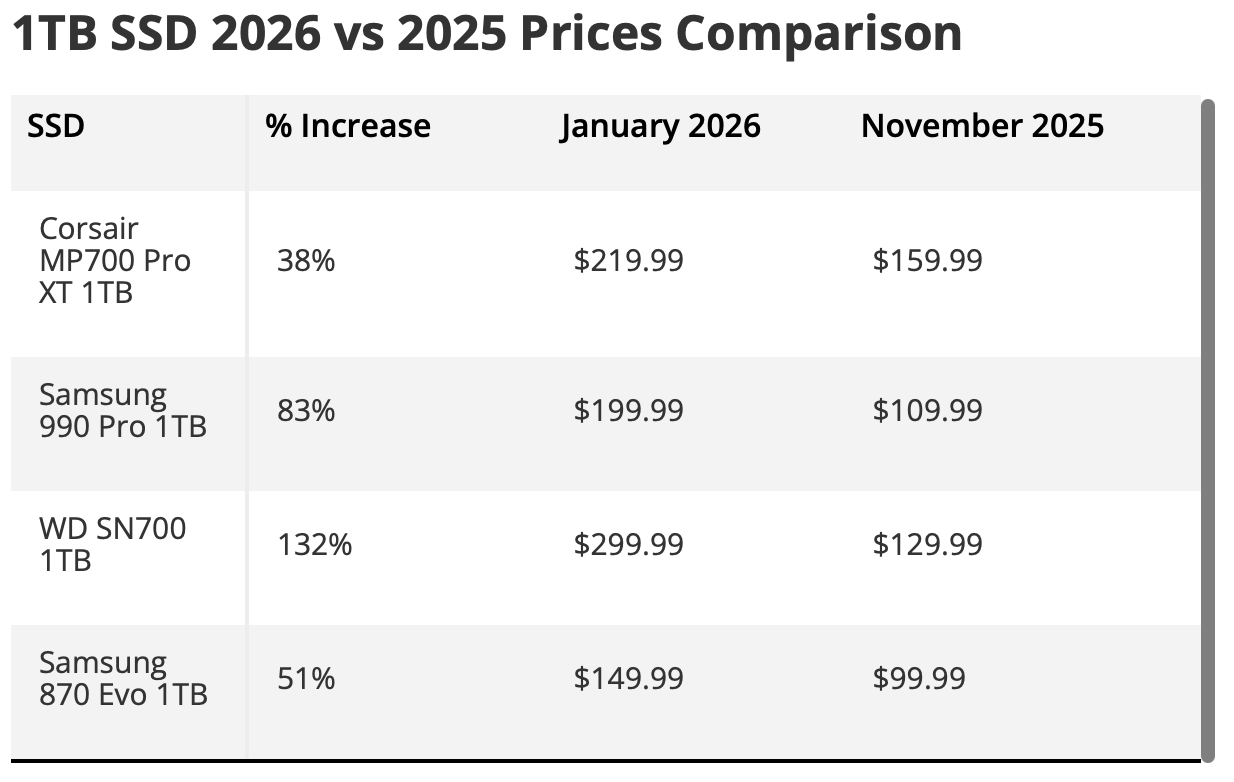
Tom’s Hardware quoted the company’s CEO as saying “The days of cheap 1TB SSDs for around ¥7000 yen (about $45 at current rates) are over,” and it further illustrated the point with this table comparing 1 TB SSD prices in November last year with January this year. That’s a two month gap.
That’s just the start of it too. The Wall Street Journal quotes sources saying that manufacturing capacity for certain types of memory is now being sold up to 2028.
Data centers, both conventional and for AI, will consume more than 70% of the high-end memory chips all manufacturers will produce in 2026, and would take even more if they could, according to TrendForce.
The big smartphone manufacturers such as Apple and Samsung have secured memory for 12-24 months in advance, so we are unlikely to see short term prices rise there. IDC reckons though that we won’t see RAM upgrades, the industry sticking to 12GB for Pro models rather than increasing to 16GB.
PC OEM manufacturer Compal says that memory chips that typically account for about 15% to 18% of a PC's materials cost could now rise to as much as 35% to 40%, putting pressure on retail prices.
Analysts report DRAM price increases of around 50% year-to-date, with further rises expected in 2026
 The impact is uneven, but the pressure is most acute for anyone that relies on large amounts of fast memory and storage. As a rule of thumb, the closer a workflow is to raw media, or processes such as real-time rendering or high-performance compute, the more exposed it is to the current memory shortage.
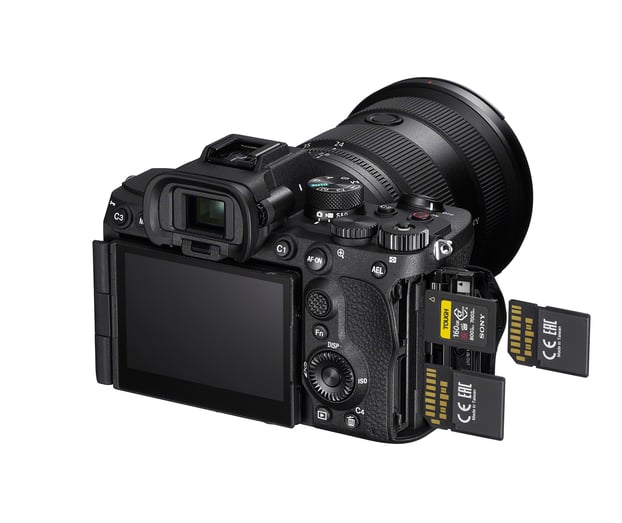
Rising NAND prices are pushing up the cost of CFexpress, SDXC and other high-capacity camera cards. Supply constraints are also increasing lead times, particularly for media suited to the higher end 6K/8K, RAW and high-frame-rate capture. Vendors and analysts warn that media costs and lead times will worsen through 2026.
Exposed through higher prices for RAM-heavy workstations, GPUs and fast NVMe SSDs. We’re hearing reports that facilities are delaying upgrades or scaling back specifications as DRAM and SSD costs climb. There is also an accompanying increase of interest in cloud and virtualised workflows
Nearline storage, enterprise SSDs and hybrid HDD/SSD systems are becoming more expensive. This is affecting archive expansion, shared storage upgrades and cloud-backed workflows.
Studios using real-time engines and large asset pipelines depend on high-RAM systems and fast storage. Memory price inflation is pushing up workstation and build-server costs, with the cloud looking ever more tempting here too.
Freelancers and small teams are hit indirectly via more expensive laptops, desktops and storage upgrades. We seem to be in the foothills of this at the moment, so if you need new kit then jumping now may be advantageous. As the year progresses, refresh cycles might be harder to justify
Is there hope on the horizon? Possibly. In the same way that the shortage of GPUs because of their use in crypto mining eventually faded as crypto became too expensive to produce, so there is a chance that the AI data centre build will be slowed by market forces. It’s not that AI is useless, it’s that the sector has over-promised and is currently under-delivering.
Investors were sold on AI being transformative across the entire world of work and much of the investment going on now is rampantly speculative. However, the future seems to be arriving more slowly than the AI acolytes anticipated.
Analysis in The Economist notes that while investor expectations for AI growth remain very high, recent surveys show business adoption plateauing or slower than expected. Indeed, adoption has fallen sharply at the largest businesses in the US. “Three years into the generative-ai wave, demand for the technology looks surprisingly flimsy,” says the magazine.
The question is when demand will start to fall off, either when the AI bubble bursts (which we still reckon it will) or deflates slowly? And when it does, how long it will take for that to percolate through a system with long lead times and ease the throttling of the DRAM and NAND Flash that we all need so much of.
To be honest, it’s unlikely that even a sudden collapse will change the trajectory of memory prices in 2026 too much. And, if that does happen, given the trillions riding on AI investment, we might all have a few other things to worry about anyway.
Tags: Technology Storage Memory


RedShark 2020 @ All rights reserved.

Comments